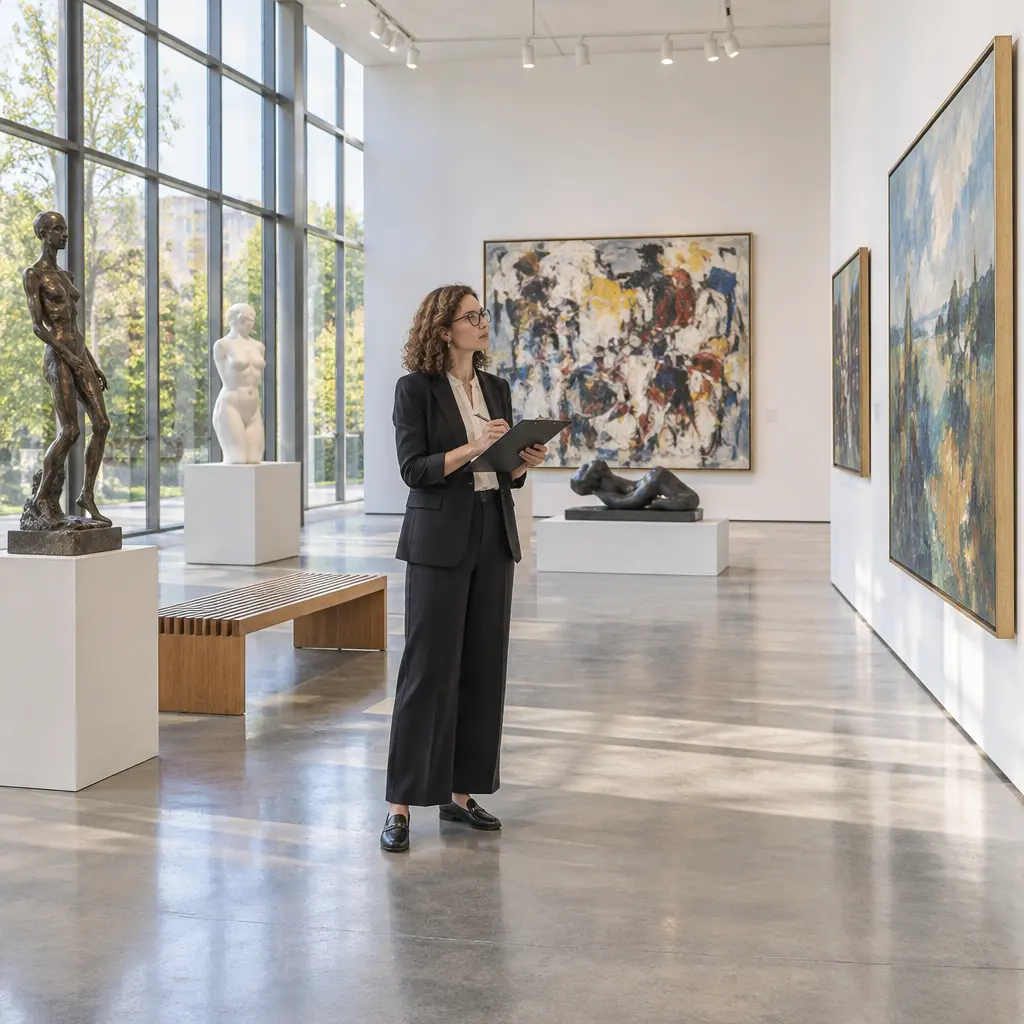
An art gallery’s selection process is the set of decisions through which its curators and directors choose, interpret, and present artworks to the public. Galleries balance artistic quality, institutional mission, audience relevance, practical constraints, and—especially in commercial spaces—market considerations. The choices matter: the National Endowment for the Arts reported that 28% of U.S. adults visited an art exhibit in person in 2022, making exhibitions an important point of contact between artists and the public. Understanding how galleries select work means looking at curatorial criteria, acquisition and business models, representation and access, and the logistics that turn a shortlist into an exhibition.
Galleries choose exhibitions through curatorial selection criteria
Curatorial selection criteria are the principles and practical tests a gallery uses to decide which artworks, artists, or themes it will present. The American Alliance of Museums describes curatorial work as involving research, interpretation, stewardship, and public engagement; in practice, selection is not a single universal checklist but a judgment shaped by each institution’s mission and resources.
Common criteria include artistic strength, originality, relevance to a gallery’s program, coherence among works, feasibility, and the potential to engage audiences. A museum may prioritize historical significance or research, while a commercial gallery may also consider whether its collectors are likely to respond to an artist’s work. These criteria overlap, but their relative weight differs by gallery type.
Artistic quality, originality, and coherence
Artistic quality is a considered assessment of how effectively a work uses its medium, ideas, and form; it is not a numerical score or an objective standard shared by every curator. Reviewers may consider technical command, experimentation, conceptual clarity, and the distinctiveness of an artist’s practice. Coherence matters when multiple works are shown together: the exhibition should create a meaningful relationship among them without making every work look the same.
For example, a curator organizing a group show might select artists who approach a shared subject through different materials or viewpoints. The connecting idea gives visitors a route through the exhibition, while the differences keep it from becoming repetitive. Museums often support these decisions with research and interpretation; the American Alliance of Museums’ professional guidance emphasizes the importance of placing objects in context rather than presenting them as isolated attractions.
Mission fit and audience relevance
Mission fit means that a proposed exhibition advances the gallery’s stated purpose, collecting focus, or community role. A university gallery may foreground teaching and experimentation; a local nonprofit may prioritize artists from its region; and a museum may connect an exhibition to its collection or research program. Audience relevance asks whether the subject can invite meaningful engagement, not merely whether it is popular.
The National Endowment for the Arts’ 2022 Survey of Public Participation in the Arts found that 28% of U.S. adults attended an art exhibit in person during the year. That figure illustrates the reach of exhibitions, but it does not mean galleries should select only familiar or widely appealing work. Many institutions instead build access through clear interpretation, varied programming, and exhibitions that introduce audiences to unfamiliar artists and histories.
Feasibility, condition, and responsible care
Feasibility is the practical assessment of whether a proposed show can be installed and cared for safely within a gallery’s budget, schedule, space, and technical capacity. Staff may check an artwork’s condition, dimensions, lighting needs, transport requirements, insurance, and installation method. For loaned works, lenders and borrowing institutions also agree on handling, security, and environmental conditions.
These practical checks can shape selection without replacing artistic judgment. A large installation may be compelling but unsuitable for a small room, while fragile materials can require conservation measures that a venue cannot provide. The American Alliance of Museums’ standards and ethics guidance treats responsible stewardship as a core museum obligation, linking the choice to exhibit an object with the institution’s ability to protect it.
Gallery types shape how exhibition choices are made
A gallery’s organizational model affects who makes selection decisions, what success means, and how money enters the process. The broad categories include commercial galleries, nonprofit and public galleries, university galleries, and artist-run spaces. These are hyponyms of the wider category “art gallery,” and their differences help explain why the same artist or proposal may be a strong fit for one venue but not another.
Commercial galleries: artistic program and market response
A commercial gallery selects work for exhibitions while also building relationships with artists, collectors, and art advisers. Directors and curators commonly consider the strength and consistency of an artist’s practice, how the work fits the gallery’s program, collector interest, pricing, and the gallery’s capacity to promote and sell it. Sales can help sustain the business and support artists, but a gallery’s program may also include work chosen for its cultural or critical importance rather than immediate commercial demand.
The market context is substantial: Art Basel and UBS’s 2024 Art Market Report estimated global art sales at $65 billion in 2023, down 4% from 2022. That estimate covers the wider art market, not gallery exhibition decisions alone. It nevertheless shows why commercial galleries must weigh artistic commitments alongside economic conditions and the costs of presenting and promoting a show.
Museums and public institutions: research, collections, and public purpose
Museum and public-gallery selection often connects exhibitions to a permanent collection, scholarly research, education, or a public mandate. Curators may develop a proposal over several years, consult conservators and subject experts, and seek loans from other institutions. A show can bring new attention to collection objects, address a historical gap, or present new research and artistic perspectives.
The Institute of Museum and Library Services’ public data and museum-sector reports document the scale and variety of U.S. museums, from large encyclopedic institutions to small local organizations. Their resources differ considerably, so a public mission does not eliminate practical limits. Curators still have to align a proposal with available staff, funding, collection care, and the institution’s exhibition calendar.
University and artist-run galleries: experimentation and community
University galleries frequently select exhibitions that support teaching, research, and exchange among students, faculty, artists, and the public. Artist-run spaces may give priority to emerging practices, collaborative projects, or work that commercial and larger institutions are less likely to show. In both settings, proximity to a defined community can make experimentation and direct participation central selection values.
These spaces can also test ideas before they reach larger venues. A student-curated exhibition, for example, may pair contemporary work with archival material and invite visitors to question how collections are formed. Their scale does not make their choices inconsequential: they can provide early visibility, professional experience, and a platform for voices underrepresented elsewhere.
Galleries develop proposals through networks and review
After establishing what fits its program, a gallery must find artists and proposals to consider. Selection can begin with curator research, studio visits, recommendations, artist submissions, open calls, or relationships with other institutions. The route matters because it influences which artists are seen and whose work receives sustained attention.
Curator research, referrals, and studio visits
Curator research involves following artists’ work, visiting studios and exhibitions, reading criticism, and consulting colleagues or community partners. Studio visits can help curators understand how an artist’s practice develops beyond a finished work on a wall. Referrals from artists, galleries, scholars, and collectors can bring work to attention, but responsible review requires evaluating the work itself rather than relying only on reputation.
This relationship-based process is especially common for exhibitions planned well in advance. It lets curators consider an artist’s broader body of work, discuss installation possibilities, and assess whether a proposal can mature into a coherent show. It can also reproduce existing networks if institutions repeatedly hear about artists from the same circles, which is why many galleries supplement referrals with open calls and targeted outreach.
Open calls, submissions, and juried review
An open call invites artists to submit work or proposals under published conditions, such as a theme, eligibility rule, deadline, and application format. A juried review is a selection process in which one or more reviewers assess submissions against stated criteria. These methods can widen access beyond existing professional networks, although application fees, time demands, and the quality of the call’s outreach can still affect who applies.
A clear process normally explains what materials are required, how decisions will be made, whether reviewers are paid, and when applicants will hear back. Galleries may request images, an artist statement, a résumé, and installation details. Because a proposal can be strong while the space or schedule is unsuitable, a rejection does not necessarily indicate that the work lacks artistic merit.
Representation, access, and selection bias
Representation refers to which artists, communities, histories, and forms of practice appear in a gallery’s program. Selection bias can occur when decision-makers favor familiar networks, training pathways, materials, or subjects, even without intending to exclude others. Galleries can examine this by reviewing their exhibition histories, submission patterns, acquisition records, and the composition of their advisory or selection groups.
The Smithsonian American Art Museum’s 2022 report on the representation of women artists in its collection found that women accounted for about 18% of artists represented in the museum’s collection. This is a collection-specific finding, not a measure of every gallery or current exhibition program, but it demonstrates how long-standing institutional choices can leave measurable gaps. Transparent criteria, broader outreach, paid opportunities, and periodic review can help galleries identify and address such patterns.
Selected artworks become exhibitions through planning and interpretation
Choosing work is only the beginning. Once a gallery approves a proposal, staff shape the exhibition through object lists, loans, budgets, interpretation, design, installation, and public programming. These decisions influence what visitors notice and how they understand the work, so exhibition-making extends the selection process rather than merely displaying its result.
Exhibition narrative and interpretation
An exhibition narrative is the organizing idea that connects artworks for visitors. Curators may express it through the selection and order of works, wall texts, labels, catalogues, audio, and events. A strong narrative offers context and invites interpretation without insisting that every visitor reach the same conclusion.
Interpretive choices can also correct gaps in the historical record. A gallery might pair an artwork with archival documents or commission an essay that explains the social conditions in which it was made. Accessible language and multiple forms of interpretation help people with different levels of art-historical knowledge engage with the exhibition.
Budget, installation, and loans
The exhibition budget covers costs such as artist fees, shipping, insurance, fabrication, installation, conservation, publications, and promotion. A gallery may revise its selection when a work cannot be transported safely or when fabrication exceeds available funds. For loans, institutions coordinate with lenders over condition reports, packing, transport, security, and display requirements.
These decisions are not administrative details separate from curating. The scale and materials of selected works affect the visitor’s experience, while fair payment and clear agreements affect artists’ ability to participate. Planning early allows a gallery to identify constraints and, where possible, find alternative funding or presentation methods without compromising care.
Evaluation and learning after the exhibition
Evaluation is the process of assessing whether an exhibition met its artistic, educational, and organizational goals. Galleries may track attendance, participation in programs, visitor feedback, press coverage, sales, and responses from artists and lenders. No single metric captures an exhibition’s value: attendance can indicate reach, while interviews or surveys may reveal whether visitors found the interpretation useful.
The National Endowment for the Arts’ participation data offer a wider benchmark for engagement with the arts, but each gallery should interpret local results in context. A small specialist exhibition may serve its community exceptionally well without drawing blockbuster crowds. Reviewing outcomes helps institutions refine future themes, improve access, and make selection decisions more transparent.
Conclusion: gallery choices shape what the public can see
Galleries choose what to show by weighing artistic quality, coherence, mission fit, audience relevance, responsible care, and practical feasibility. Their organizational type influences how those criteria are balanced: commercial galleries consider market conditions, while museums, university venues, nonprofits, and artist-run spaces may emphasize research, education, experimentation, or community. Curator networks and open calls determine which proposals reach review, and exhibition planning turns selected work into a public experience.
These choices shape artistic visibility and the stories institutions tell about culture. Readers can learn more by reviewing a gallery’s stated mission, exhibition history, submission policies, and accessibility practices. For artists, a proposal that explains its relationship to the venue’s program—and addresses space, timing, and care—can make the selection process clearer and more productive.
Sources: National Endowment for the Arts, 2022 Survey of Public Participation in the Arts, https://www.arts.gov/impact/research/publications/2022-survey-public-participation-arts; American Alliance of Museums, Standards and Excellence Program and Code of Ethics for Museums, https://www.aam-us.org/programs/ethics-standards-and-professional-practices/; Art Basel and UBS, The Art Market 2024, https://www.artbasel.com/about/initiatives/the-art-market; Institute of Museum and Library Services, Museum Data Files, https://www.imls.gov/research-evaluation/data-collection/museum-data-files; Smithsonian American Art Museum, Representation of Women Artists in the Collection, 2022, https://americanart.si.edu/research/publications/representation-women-artists