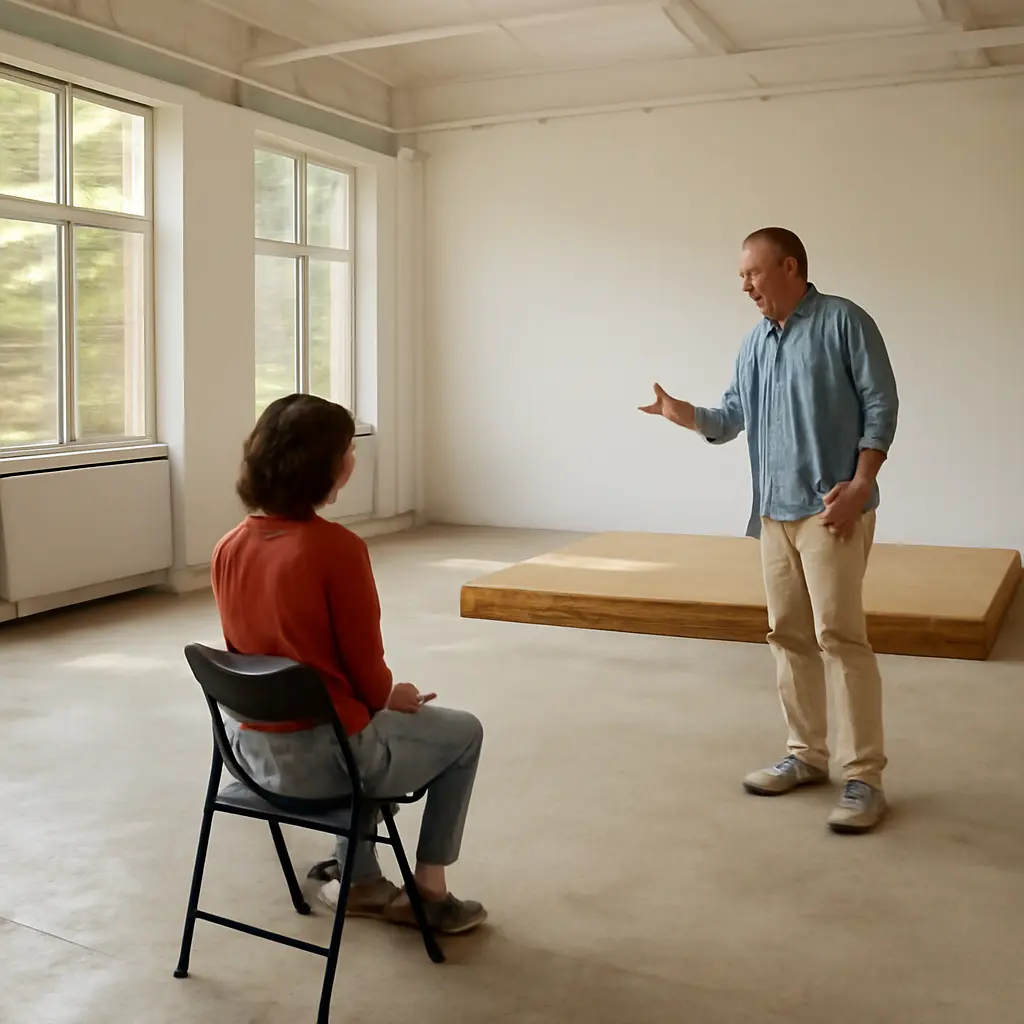
Performance art is live work in which artists use their bodies, actions, time, and presence as central materials. For venues, that means the essential resource is not an object to display but the conditions that let a live encounter happen safely and meaningfully. A venue’s performance-art responsibility therefore extends beyond providing a stage: it includes artist-led planning, access, audience consent, technical flexibility, and care before, during, and after the event. These demands are especially relevant as the U.S. Bureau of Economic Analysis reported that arts and cultural production contributed $1.1 trillion—4.2% of U.S. GDP—in 2022, while live performance depends on practical infrastructure as much as artistic vision.
Presence and Performance-Art Venue Responsibilities
Performance art is often deliberately difficult to reduce to a fixed object. The Tate describes it as art in which the artist’s actions, usually in front of an audience or camera, constitute the work. This definition shifts a venue’s focus from conservation of an artwork alone to stewardship of the circumstances surrounding an event: bodies, duration, space, sound, audience relationships, and documentation.
There is no single technical standard for hosting performance art. A quiet durational piece, an audience-participation work, and a movement-based performance may call for very different environments. The shared requirement is a venue willing to plan with the artist rather than impose a default theatre or gallery format. That principle connects directly to the first practical demand: making the space serve the work.
Space that serves the action
Spatial responsiveness means adapting the room to the performance’s specific physical and social requirements. A work might need an open floor, a visible exit, a particular distance between performer and audience, darkness, a controlled sightline, or permission to move through more than one part of a building. Tate’s account of performance art emphasizes the artist’s actions as the work; consequently, the venue’s layout is not neutral background but part of the conditions that shape those actions.
Venues should discuss capacity, floor surfaces, temperature, lighting, acoustics, power, storage, and audience circulation with artists before confirming a setup. A conventional seated arrangement may be inappropriate for a piece that asks viewers to move, while a standing audience may create barriers for people who need seats. The relevant measure is not how closely the room resembles a standard black box, but whether it supports the intended work without compromising safety or access.
Technical flexibility and production planning
Technical flexibility is a venue’s ability to adjust equipment and operating procedures to the performance rather than assuming every work requires the same lighting, sound, rigging, or backstage arrangement. The National Endowment for the Arts’ Our Town program treats creative placemaking as collaboration among artists, organizations, and communities, a useful model for performance planning: decisions about a site should be made with the people whose work and experience the site will shape.
A practical production conversation should establish what the artist needs, what the venue can provide, who controls cues, and what changes require approval. It should also identify limits early: for example, whether a room can support amplified sound, whether an installation may be attached to a wall, or whether a performance can continue if a technical element fails. Clear agreements protect artistic intent while preventing last-minute improvisation from turning into avoidable risk.
Care and Consent in Performance-Art Venues
Once the physical environment is established, the venue must attend to the people in it. Performance art can involve close proximity, participation, sensitive subjects, physical exertion, or prolonged exposure. A care-centered venue anticipates these possibilities with the artist and communicates expectations clearly, without treating every performance as if it carries identical risks.
Audience consent and participation
Audience consent means that viewers understand what participation may involve and can make an informed choice about joining in. Participation can range from being addressed directly to moving, speaking, touching an object, or entering a performer’s space. The venue should help the artist communicate relevant boundaries before the event and provide a meaningful way to decline participation without penalty or embarrassment.
This is particularly important when a work involves touch, personal disclosure, or interaction with people who have not volunteered. A short pre-show notice, a facilitator, or clear signage may be appropriate depending on the piece. The goal is not to remove uncertainty or artistic intensity; it is to distinguish deliberate artistic challenge from unclear expectations or coercion.
Accessibility as a production condition
Accessibility is the planning of practical and sensory conditions that allow people with different bodies and communication needs to participate. The U.S. Department of Justice’s ADA guidance identifies effective communication as a core obligation for public accommodations, including through appropriate auxiliary aids and services when needed. For a performance venue, access may involve step-free routes, seating options, captioning, interpretation, audio description, relaxed arrival procedures, or advance information about sensory conditions.
Access should be discussed during production, not added only after the performance is designed. A standing-only work, for example, may need seated viewing positions; a performance with sudden loud sound may benefit from advance notice and a quieter exit route. Because access requirements vary by work and audience, venues should consult artists and audience members, state what is available, and avoid promising accommodations they cannot reliably deliver.
Health, safety, and duty of care
Duty of care is the venue’s responsibility to take reasonable steps to reduce foreseeable harm to artists, staff, and audiences. The Occupational Safety and Health Administration’s general industry framework requires employers to address workplace hazards; performance planning should similarly identify relevant risks, such as trip hazards, heavy equipment, heat, fatigue, crowding, or use of unfamiliar materials. The exact precautions depend on the work and the building.
A proportionate risk assessment can clarify who is responsible for first aid, emergency communication, equipment checks, crowd management, and stopping the performance if conditions become unsafe. For durational works, venues should discuss breaks, hydration, changing conditions, and the artist’s authority to pause. The assessment should support the work rather than function as a blanket reason to reject unfamiliar forms.
Time, Documentation, and the Life of Performance Art
Performance’s live character raises questions that do not apply in the same way to an object-based exhibition: how long the work lasts, what remains afterward, and who controls its record. Venues can respect the event’s particular form by agreeing on duration and documentation before the audience arrives.
Duration and audience movement
Duration is the time structure of a performance, which may be fixed, repeated, or open-ended. A venue hosting a long work should confirm opening hours, staffing, audience entry and exit, performer breaks, and any limits on remaining in the space. Clear information helps audiences decide whether they can attend without dictating how they must experience the work.
For a performance that allows people to come and go, staff should understand whether late entry is permitted and how to avoid disrupting the work. For a piece that requires uninterrupted attention, ticketing and audience briefings may need to reflect that condition. These choices are artistic and operational at once, so they should be resolved collaboratively.
Documentation, rights, and preservation
Documentation includes photographs, video, audio, notes, and other records made during or after a performance. It can help an event reach people who were not present, but it is not automatically equivalent to the live work. Tate’s definition, centered on the artist’s actions, helps explain why a recording may preserve evidence of a performance without reproducing the original encounter.
Before documenting, venues should agree with artists on whether recording is allowed, who may record, how images can be used, and whether audience members need notice or consent. Contracts and release procedures should address ownership and permissions rather than assuming that a venue’s access to the room includes unrestricted rights to publish the event. For some works, the artist may prefer no documentation at all; honoring that choice is part of respecting the work’s form.
Community Context and Venue Practice
A performance venue is also a meeting point between an artist, a local community, and an institution. This relationship can influence who feels welcome, what kinds of work are supported, and whether the venue learns from an event after it ends. The National Endowment for the Arts’ creative-placemaking framework is relevant here because it emphasizes partnership and local context rather than treating cultural activity as a transaction between venue and audience.
Local partnership and audience trust
Community-responsive programming means working with local partners and audiences to understand the setting in which a performance takes place. A venue might collaborate with a neighborhood organization on outreach, invite community advisors to discuss access, or share clear information about content and participation. These steps can build trust, particularly when a work engages with local histories or public spaces.
The arts’ economic scale reinforces the importance of this infrastructure without reducing its value to revenue. The Bureau of Economic Analysis reported that arts and cultural production accounted for $1.1 trillion, or 4.2% of U.S. GDP, in 2022. That broad measure covers many industries and does not isolate performance art; it nevertheless demonstrates that cultural activity is a substantial part of the economy, supported by venues, workers, and community relationships.
A practical venue checklist
A concise checklist can turn principles of presence and care into repeatable practice. Before confirming a performance, venues can ask:
- What spatial, technical, and timing conditions are essential to the artist’s work?
- What audience participation is expected, and how will people be informed that they may decline?
- What access provisions are available, and what needs to be arranged in advance?
- What foreseeable safety concerns require a plan, and who has authority to pause the event?
- What documentation, image permissions, and audience privacy arrangements have been agreed?
- How will the venue and artist review the event afterward and address any concerns?
This checklist is not a substitute for artist-specific planning. It is a starting point for conversations that make expectations visible and help the venue adapt without taking control of the work.
Conclusion: Presence Is the Venue’s Central Resource
Performance art asks venues to support presence rather than simply display objects. That responsibility begins with responsive space and technical flexibility, extends through consent, accessibility, and safety, and continues into decisions about duration, documentation, and community relationships. The definition offered by Tate, the ADA’s communication guidance, OSHA’s workplace-safety framework, and the NEA’s partnership-oriented approach each illuminate a different part of that work.
Venues can put these ideas into practice by involving artists early, being transparent about limitations, planning access and care as part of production, and agreeing on documentation before the event. For further action, organizations can review their production and accessibility procedures with artists, staff, and local audiences, then revise them based on what those conversations reveal. The strongest venue is not necessarily the most elaborate one; it is the one that makes a live encounter possible while treating everyone involved with care.
Sources: Tate, “Performance Art,” https://www.tate.org.uk/art/art-terms/p/performance-art; U.S. Bureau of Economic Analysis, “Arts and Cultural Production Satellite Account, U.S. and States, 2022,” https://www.bea.gov/news/2024/arts-and-cultural-production-satellite-account-us-and-states-2022; National Endowment for the Arts, “Our Town,” https://www.arts.gov/impact/creative-placemaking/our-town; U.S. Department of Justice, “ADA Requirements: Effective Communication,” https://www.ada.gov/resources/effective-communication/; Occupational Safety and Health Administration, “General Duty Clause,” https://www.osha.gov/laws-regs/oshact/section5-duties.