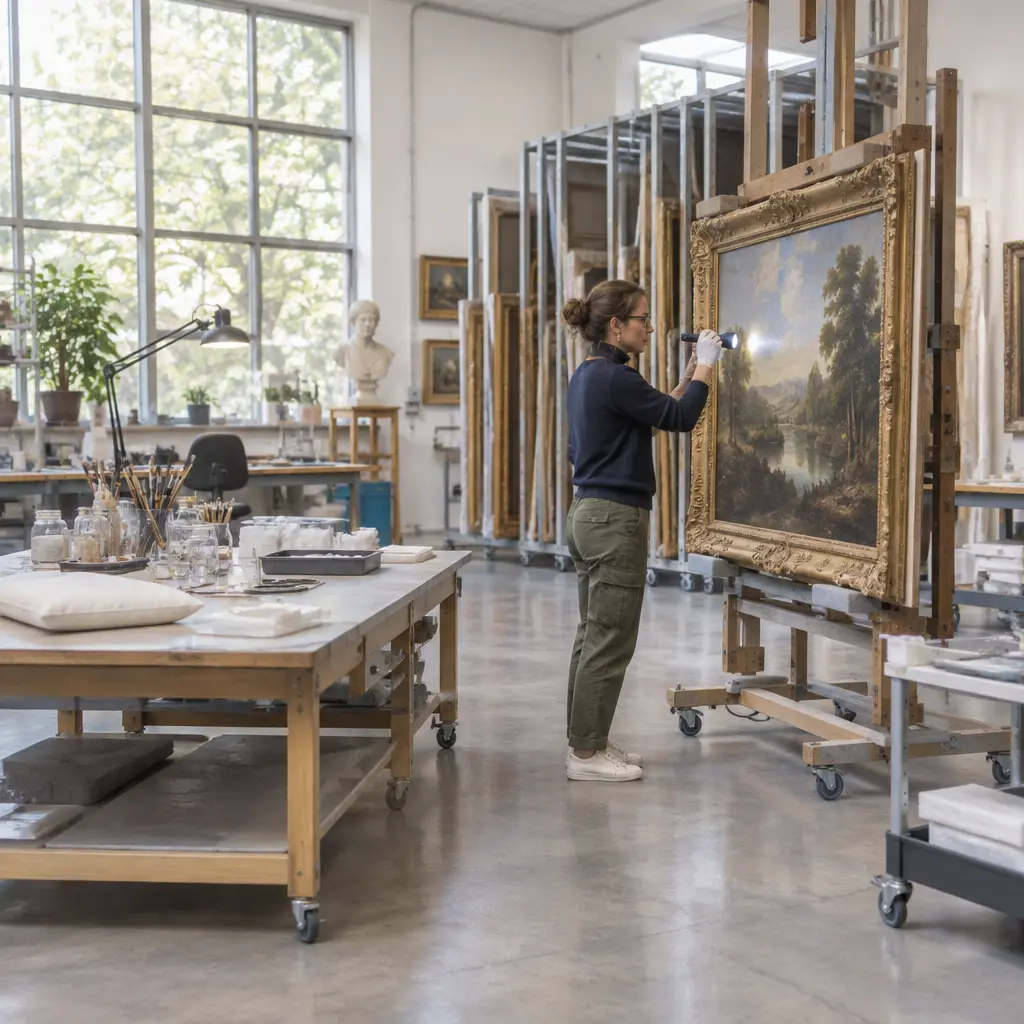
Museums preserve art by controlling the conditions around it, documenting its history, and treating damage with methods designed to protect—not erase—the object’s original materials. The International Council of Museums describes conservation as preventive, remedial, and restoration work; together, these approaches help institutions manage risks from light, humidity, pests, handling, and aging. The scale is substantial: UNESCO estimates that the world has more than 100,000 museums, safeguarding collections that connect communities with history and creativity. Climate control, conservation science, disaster planning, and responsible public access all contribute to keeping art available for future generations.
Museum conservation protects art through prevention and treatment
Museum conservation is the professional care of cultural objects to slow deterioration and, when necessary, address existing damage. The International Council of Museums’ Committee for Conservation distinguishes preventive conservation, which reduces risks before damage occurs; remedial conservation, which stabilizes an object; and restoration, which aims to make an object’s appearance more understandable or complete. These categories are related but not interchangeable: restoration is only one part of conservation, and interventions should be justified by an object’s condition, history, and intended use.
A central principle is minimal intervention. Conservators document an object before and after work, choose materials compatible with its construction, and make treatments as reversible as practical. The American Institute for Conservation’s professional guidance also emphasizes that decisions should respect an object’s significance and be supported by examination and research. In practice, this means a treatment that suits a cracked oil painting may be inappropriate for a textile, photograph, sculpture, or contemporary artwork made from plastics.
Preventive conservation reduces everyday risks
Preventive conservation means managing the environment and handling practices that affect collections. Museums monitor temperature and relative humidity, limit damaging light and ultraviolet exposure, maintain clean storage, inspect for pests, and use suitable mounts and display cases. The Smithsonian Museum Conservation Institute notes that light damage accumulates over time and can cause fading and chemical change; unlike many environmental risks, light damage is generally irreversible. For that reason, museums may rotate sensitive works off display or use low illumination.
There is no single climate setting suitable for every collection. Wood, canvas, paper, metal, and composite materials respond differently to changes in temperature and moisture. Museums therefore consider the materials in an object, the building’s capabilities, and the risks of rapid fluctuations rather than relying on a universal number. The Canadian Conservation Institute’s guidance on agents of deterioration identifies factors such as incorrect temperature and relative humidity, light, pollutants, pests, physical forces, and dissociation—the loss of information that occurs when an object becomes separated from its records.
Remedial conservation stabilizes existing damage
Remedial conservation is direct work on an object to arrest active deterioration or strengthen it for safe storage, research, or display. A conservator might secure flaking paint, mend a tear, remove harmful corrosion products, or create a supportive mount. Before selecting a treatment, specialists examine the object, identify its materials, and assess how the proposed intervention could affect its appearance and long-term stability.
Scientific analysis can help answer those questions. Imaging, microscopy, and materials analysis may reveal earlier repairs, hidden layers, or the composition of pigments and supports. Such information helps conservators distinguish original features from later alterations and choose appropriate treatment methods. The goal is not to make every artwork look new; it is to preserve significant material and prevent avoidable loss.
Museum environmental control limits damage to collections
Environmental control is the management of conditions surrounding an artwork so that deterioration slows without creating new risks. It includes climate, light, air quality, display design, and storage. Conservation professionals increasingly weigh the needs of objects against energy use, building limitations, and local climate. The American Institute for Conservation’s environmental guidelines explain that collections care should be based on risk and material sensitivity, rather than treating one rigid temperature and humidity target as suitable for all institutions.
Temperature and humidity management
Relative humidity describes how much water vapor the air holds compared with the maximum it could hold at that temperature. Fluctuations can cause hygroscopic materials—such as wood, paper, canvas, and some adhesives—to swell or shrink. Repeated movement can contribute to warping, cracks, loose joints, and paint loss. Museums use environmental sensors and building systems to track conditions, but they also adapt storage and display choices to an object’s specific vulnerabilities.
Stable conditions matter because abrupt changes can be more damaging than a carefully managed environment that is not identical to another museum’s. Institutions may use sealed cases or microclimates to protect especially sensitive objects, creating a more controlled small environment without conditioning an entire building to the same degree.
Light and pollutants are managed selectively
Visible light and ultraviolet radiation can fade dyes, pigments, and paper, while pollutants can react with or deposit on collection materials. Museums reduce exposure by using filtered lighting, limiting illumination levels, shortening display periods, and keeping sensitive objects away from direct sunlight. Storage areas and display cases may also use barriers and filtration to reduce dust and airborne contaminants.
These measures influence what visitors see. A work on paper may be displayed for a limited period and then returned to dark storage, while a more light-stable object may remain on view longer. Rotations are not merely exhibition choices; they are a practical preservation strategy that balances public access with the cumulative effects of exposure.
Museum collections are protected through documentation and risk planning
Preservation depends on information as well as physical care. Collection records identify an object, describe its materials and condition, track its location and ownership history, and record examinations or treatments. Good documentation supports conservation decisions and reduces dissociation—the risk that an object will lose its identity, context, or associated records. It also helps museums respond efficiently when objects are moved, loaned, or affected by an emergency.
Cataloguing and digital records preserve context
Cataloguing creates an organized record of each object, including such details as creator, date, materials, dimensions, provenance, condition, and location. Photographs and digital records can document changes over time and make collection information available to researchers. Digital systems do not replace the artwork or its physical documentation, but they make it easier to locate records, share information, and maintain continuity when staff or storage arrangements change.
Documentation also supports responsible stewardship. If a museum cannot establish what an object is, where it came from, or what treatment it has received, future researchers and conservators have less evidence on which to base decisions. Clear records are therefore part of preservation, not simply administration.
Disaster preparedness protects people and collections
Disaster planning prepares museums to prevent, respond to, and recover from events such as fires, floods, storms, earthquakes, and equipment failures. Plans typically identify collection priorities, emergency contacts, evacuation routes, salvage supplies, and procedures for drying or stabilizing damaged objects. Staff training and practice exercises matter because a written plan is useful only if people can apply it safely under pressure.
Climate-related hazards make preparedness increasingly relevant. The Intergovernmental Panel on Climate Change reports that human-caused climate change is already affecting weather and climate extremes across regions. For museums, this can mean reassessing flood exposure, heat risks, building systems, and emergency access. Risk planning should therefore be reviewed regularly rather than treated as a one-time document.
Museum conservation balances public access with long-term care
Museums preserve art for future generations while making it meaningful to people today. The challenge is to provide access without exposing objects to unnecessary handling, light, environmental change, or security risks. Curators, conservators, registrars, facilities teams, and educators work together to determine how an object can be displayed, studied, loaned, or shared digitally while remaining safe.
Exhibition and handling practices reduce wear
Exhibition preparation includes condition checks, safe transport, appropriate mounts, secure cases, and environmental monitoring. Staff use handling procedures tailored to an object’s size, weight, and materials, often wearing gloves when appropriate and using supports to avoid stress on fragile areas. For loans, museums may agree on environmental and security requirements with borrowing institutions and document an object’s condition before shipment and after its return.
Public access can also take forms that reduce physical risk. High-resolution photography, digital exhibitions, and online collection databases let people explore works that are too fragile, sensitive, or geographically distant to display. Digital access complements, rather than replaces, the experience of encountering original objects and the conservation work that makes such encounters possible.
Case study: conserving paintings and works on paper
Paintings and works on paper show how preservation strategies vary by material. A canvas painting can be vulnerable to changes in humidity that affect its support and paint layers, while a watercolor or print may be particularly sensitive to light. Museums may therefore control the display period, use protective glazing, monitor the object’s condition, and return it to dark storage when it is not on view. Conservators may also address previous repairs or unstable paint, but they first document the work and assess the effects of any proposed treatment.
The Smithsonian’s conservation resources explain why understanding an object’s material structure is essential: the same environmental condition or treatment can have different effects on different materials. This is why museums rely on trained conservators and ongoing assessment rather than a one-size-fits-all preservation recipe.
Conclusion: museum preservation is a shared responsibility
Museums preserve art through preventive conservation, carefully considered treatment, environmental control, accurate documentation, and emergency planning. These practices protect both an artwork’s physical materials and the information that gives it meaning. They also make responsible public access possible, from carefully managed exhibitions to digital collections.
Because each object and institution faces different risks, preservation requires ongoing assessment, trained staff, and support for sustainable facilities and conservation research. Readers can learn more by exploring museum conservation resources, visiting collections, and supporting institutions that care for cultural heritage. Protecting art is not only a task for conservators; it is a long-term commitment to the knowledge and creativity that future generations deserve to encounter.
Sources: International Council of Museums, “Terminology to Characterize the Conservation of Tangible Cultural Heritage,” https://icom.museum/en/resources/standards-guidelines/; American Institute for Conservation, “Code of Ethics and Guidelines for Practice,” https://www.culturalheritage.org/about-conservation/code-of-ethics; Smithsonian Museum Conservation Institute, “Museum Conservation,” https://mci.si.edu/; Canadian Conservation Institute, “Agents of Deterioration,” https://www.canada.ca/en/conservation-institute/services/agents-deterioration.html; American Institute for Conservation, “Environmental Guidelines,” https://www.culturalheritage.org/resources/collections-care; UNESCO, “Museums,” https://www.unesco.org/en/museums; Intergovernmental Panel on Climate Change, “Climate Change 2023: Synthesis Report,” https://www.ipcc.ch/report/ar6/syr/