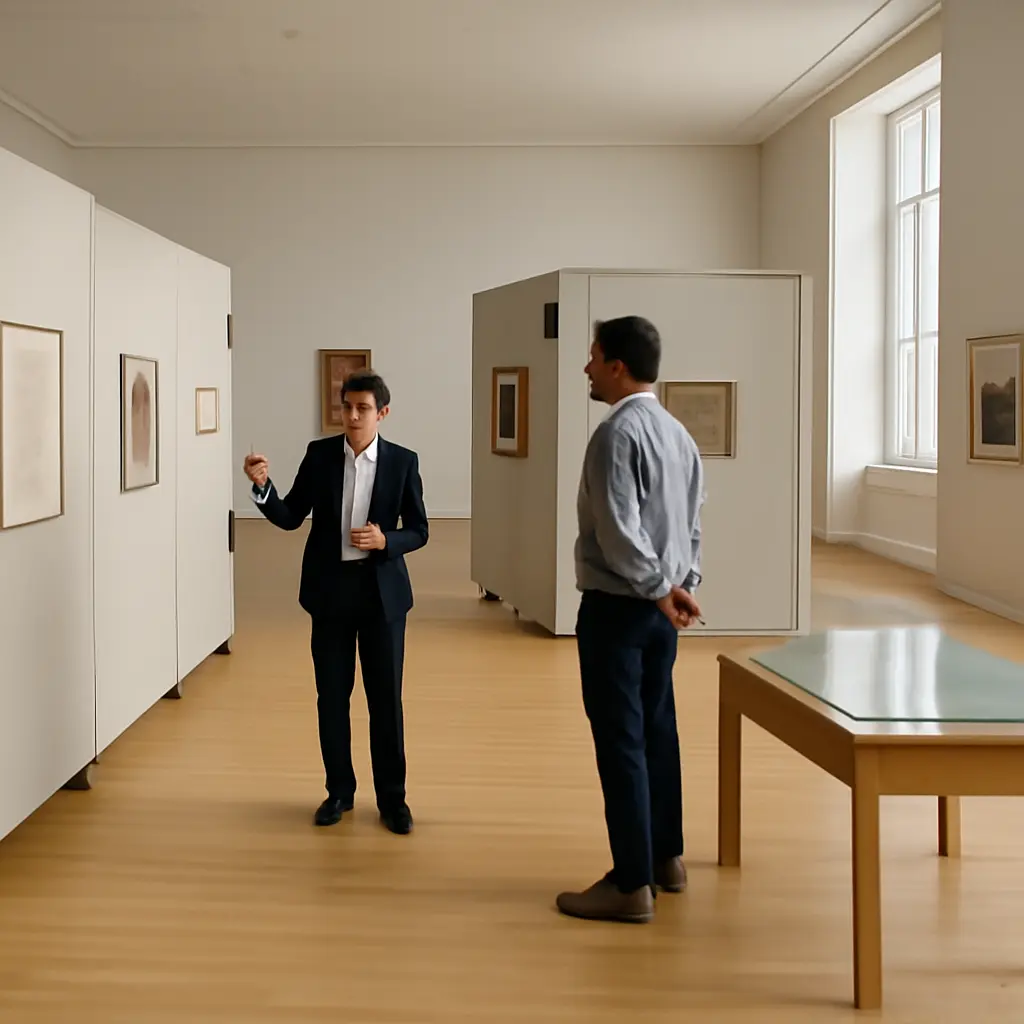
A gallery theme is the organizing idea that connects selected artworks, interpretation, spatial design, and visitor experience. Behind the scenes, developing one is less a matter of choosing a catchy title than building a defensible, workable framework: curators test the idea against collections and scholarship, teams plan for access and conservation, and educators and designers shape how visitors encounter it. The process matters at scale: the International Council of Museums reported that the world had about 104,000 museums in its 2022 report, making clear how many institutions must translate complex collections into meaningful public experiences. This article explains how gallery themes are researched, selected, developed into narratives, and evaluated after opening.
Gallery theme development: from idea to visitor experience
Theme development is the process of turning a subject, question, or interpretive argument into a coherent exhibition experience grounded in objects and evidence. The American Alliance of Museums’ exhibition-planning guidance treats exhibitions as collaborative projects, involving curatorial, design, collections, education, and operational expertise—not simply the work of one curator. A theme can be chronological, geographic, material-based, biographical, or question-led, but it must help visitors understand why the selected works belong together.
A useful theme does three jobs: it gives the project a clear purpose, guides decisions about what to include or leave out, and helps visitors make connections. For example, “Impressionism” names a movement; a more interpretive theme might ask how artists represented changing urban life. The second formulation creates a question the exhibition can investigate through artworks, labels, spatial choices, and public programs.
The central idea and interpretive claim
The central idea is the concise proposition the exhibition wants visitors to encounter. It is not necessarily a claim that every visitor must accept; rather, it provides an evidence-based point of view that makes the exhibition more than a display of related objects. The Smithsonian’s exhibition-planning resources emphasize that interpretation should connect objects with ideas and audiences, while remaining supported by research.
A practical test is to ask whether the idea can be expressed in a sentence, whether the collection can substantiate it, and whether it opens up meaningful questions. If the answer depends on objects the institution cannot borrow, document, conserve, or interpret responsibly, the concept needs revision.
Theme types and their strengths
Themes commonly take several forms. A chronological theme traces change over time; a material theme examines processes such as glassmaking or weaving; a place-based theme explores a region or community; and a question-led theme investigates an issue such as migration, identity, or the meaning of ownership. These are useful categories, not rigid rules: exhibitions often combine them.
The choice affects the visitor’s path through the exhibition. A chronological structure can make historical change legible, while a question-led structure can support comparison across periods. The team must also consider whether the chosen form risks oversimplifying contested histories or presenting a single perspective as universal.
Research and selection shape a gallery theme
Once a promising idea exists, research tests whether it is accurate, distinctive, and achievable. Curators examine collection records, provenance, conservation needs, previous scholarship, and the voices of people connected to the subject. The International Council of Museums’ 2022 definition describes museums as institutions that research, collect, conserve, interpret, and exhibit tangible and intangible heritage; theme development draws on all of these responsibilities.
Research also reveals gaps. A collection may support a compelling story while omitting the perspectives necessary to tell it fairly. In those cases, teams may seek loans, consult community members, commission new research, or narrow the exhibition’s claims. The theme should follow the evidence rather than forcing objects into a predetermined narrative.
Collection audits and object selection
A collection audit identifies which objects can carry the theme and what is known about them. Selection involves more than visual appeal: condition, display requirements, rights, provenance, interpretive relevance, and loan feasibility all matter. A visually striking object may be excluded if its history is uncertain or its conservation risks are too high.
Teams often develop a provisional checklist, then revise it as research and design progress. This iterative process helps prevent a common problem: committing to a story before confirming that the objects, documentation, and resources can support it.
Provenance, ethics, and community knowledge
Provenance research tracks an object’s ownership and movement over time. It can reveal gaps, coercion, wartime displacement, colonial acquisition, or disputed claims. The American Alliance of Museums’ guidance on repatriation and collections stewardship reflects the broader professional expectation that museums investigate these histories and respond through appropriate consultation and procedures.
Community consultation can add knowledge that collection records do not contain, including language, cultural context, lived experience, and disagreement about interpretation. Consultation is most meaningful when it begins early enough to influence the theme and decisions—not only after the exhibition text has been written.
Exhibition narratives turn themes into a sequence
A narrative is the route through which the theme unfolds. It organizes objects and interpretive material into sections, transitions, and moments of emphasis. The Association of Art Museum Curators describes curatorial work as encompassing research, interpretation, collection care, and collaboration; in practice, narrative development connects those responsibilities into a visitor-facing structure.
A strong narrative does not require a single correct route through every gallery. Visitors may enter at different points, spend unequal amounts of time, or engage through labels, audio, programs, or digital content. The underlying structure should still make relationships between objects understandable.
Sections, transitions, and label writing
Sections break a broad theme into manageable ideas. Transitions explain why one section follows another, while labels connect individual objects to the larger argument. Effective interpretive writing distinguishes established facts from interpretation, uses accessible language, and avoids asking a label to carry more information than a visitor can readily absorb.
The National Park Service’s interpretive-planning principles emphasize that interpretation should be organized around meaningful ideas and connected to the audience. Though developed for parks and heritage sites, the principle applies to galleries too: object information is most useful when it helps visitors see significance, context, or a relationship they might otherwise miss.
Design, conservation, and accessibility
Design makes the narrative spatial. Lighting, sightlines, color, casework, seating, sound, and wayfinding can clarify relationships—or compete with the art. Conservation requirements set important limits: sensitive works may need restricted light levels, stable environmental conditions, or protective cases. These constraints are not afterthoughts; they can shape the checklist and gallery layout from the start.
Accessibility is similarly integral to planning. The Smithsonian Guidelines for Accessible Exhibition Design address physical access, sensory experience, communication, and intellectual access. Useful measures may include clear routes, seating, readable text, captions, audio description, tactile opportunities where appropriate, and digital alternatives. The right combination depends on the works, venue, audience, and conservation conditions.
Project constraints determine what galleries can deliver
A compelling concept still has to work within time, budget, staffing, building, and loan constraints. Exhibition teams coordinate curators, registrars, conservators, designers, educators, preparators, writers, accessibility specialists, and communications staff. Each discipline identifies risks that may change the project: a delayed loan, an object requiring special environmental controls, or a text panel that needs translation.
The National Endowment for the Arts’ museum and arts-sector research, alongside institutional annual reports, illustrates how cultural organizations operate within varied financial and staffing conditions. There is no single budget formula that applies to all galleries; costs depend on scale, construction, shipping, insurance, loans, technology, and whether the exhibition is temporary or permanent. Responsible planning therefore builds contingencies rather than assuming every element will proceed unchanged.
Loans, schedules, and budget trade-offs
Borrowed works can expand a story, but loans involve requests, facility reports, transport, insurance, courier arrangements, and contractual deadlines. A late or declined loan may require a new object, a revised section, or a different interpretive claim. Teams reduce disruption by identifying essential objects separately from desirable additions and by setting decision deadlines.
Budget trade-offs are interpretive choices as well as financial ones. If funds do not support a complex interactive, the team might invest instead in stronger labels, translations, seating, or a simple digital resource. The key question is whether each expense serves the exhibition’s purpose and its audiences.
Collaboration and decision-making
Cross-functional collaboration helps catch problems early. Curators may define the argument, while educators test whether it makes sense to non-specialists; conservators assess display risks; registrars manage movement and documentation; and designers test how the experience will work in the room. Clear decision-making roles prevent consultation from becoming either tokenistic or endlessly unresolved.
A useful project document records the exhibition’s purpose, audience, key questions, object rationale, access goals, schedule, and unresolved risks. It gives the team a shared reference point when individual decisions—such as shortening a label or moving an object—could affect the whole narrative.
Visitor research tests whether the theme works
Visitor research evaluates whether people can find, understand, and engage with the exhibition. It may include front-end research before design, formative testing during development, and summative evaluation after opening. The Institute of Museum and Library Services supports research and evaluation across the museum field, while the Smithsonian’s audience-research practice demonstrates how visitor feedback can inform exhibition decisions.
Attendance is one measure, but it does not show by itself whether the theme was clear or meaningful. Other indicators can include visitor comments, observed movement, dwell time, participation in activities, accessibility feedback, and responses to specific interpretive questions. Measures should match the exhibition’s aims and avoid treating every visitor as if they engage in the same way.
Testing ideas before opening
Early testing can reveal whether a proposed title communicates the subject, whether a section sequence feels logical, and whether labels answer visitors’ likely questions. Teams can use interviews, small group discussions, prototype labels, mock-ups, or informal walkthroughs. Findings may lead to changes in wording, object placement, wayfinding, or the balance between text and visual material.
Testing is particularly important when a theme involves unfamiliar terminology, painful history, or multiple cultural perspectives. Feedback cannot guarantee universal agreement, but it can expose confusing assumptions and help the team explain the limits and evidence behind its interpretation.
Learning from real-world exhibitions
A practical example is an exhibition about an artist’s materials. The theme may begin with technical research into pigments and tools, then expand to include trade, labor, environmental effects, and conservation. That shift creates connections among object study, history, and contemporary questions—provided the collection and scholarship support each link.
Another example is a community-focused exhibition developed with local partners. Consultation may change which objects are featured, whose language appears in labels, and whether the story is organized by chronology or by community priorities. These cases show why the theme is a working framework: it becomes stronger when evidence, collaboration, and visitor response can refine it.
Conclusion: what galleries rarely explain
Gallery themes are developed through an iterative process: teams define an interpretive claim, test it against collections and research, consider provenance and community knowledge, build a narrative, and adapt the design to conservation, accessibility, schedule, and budget. Visitor research then helps show whether the finished experience communicates as intended. The theme visitors encounter is the visible result of many decisions they may never see.
Understanding that work makes exhibitions easier to question and appreciate. When visiting a gallery, look for the central idea, notice how objects support or complicate it, and consider whose knowledge is represented. For further reading, explore museum exhibition-planning guidance, accessibility standards, and institutional evaluation reports—and ask galleries how they developed the themes they present.
Sources: International Council of Museums, “Museums Around the World: In the Face of COVID-19,” 2022, https://icom.museum/en/news/museums-around-the-world-in-the-face-of-covid-19/; International Council of Museums, “Museum Definition,” https://icom.museum/en/resources/standards-guidelines/museum-definition/; American Alliance of Museums, “Exhibition Planning,” https://www.aam-us.org/programs/resource-library/; American Alliance of Museums, “Direct Care of Collections,” https://www.aam-us.org/programs/ethics-standards-and-professional-practices/; Smithsonian Institution, “Exhibition Planning,” https://www.si.edu/Exhibitions; Smithsonian Institution, “Smithsonian Guidelines for Accessible Exhibition Design,” https://access.si.edu/sites/default/files/accessible-exhibition-design.pdf; National Park Service, “Interpretive Development Program,” https://www.nps.gov/idp/interp/; Institute of Museum and Library Services, “Museum Research and Evaluation,” https://www.imls.gov/research-evaluation; National Endowment for the Arts, “Arts Data Profile,” https://www.arts.gov/impact/research/arts-data-profile; Association of Art Museum Curators, “About AAMC,” https://www.artcurators.org/page/About.