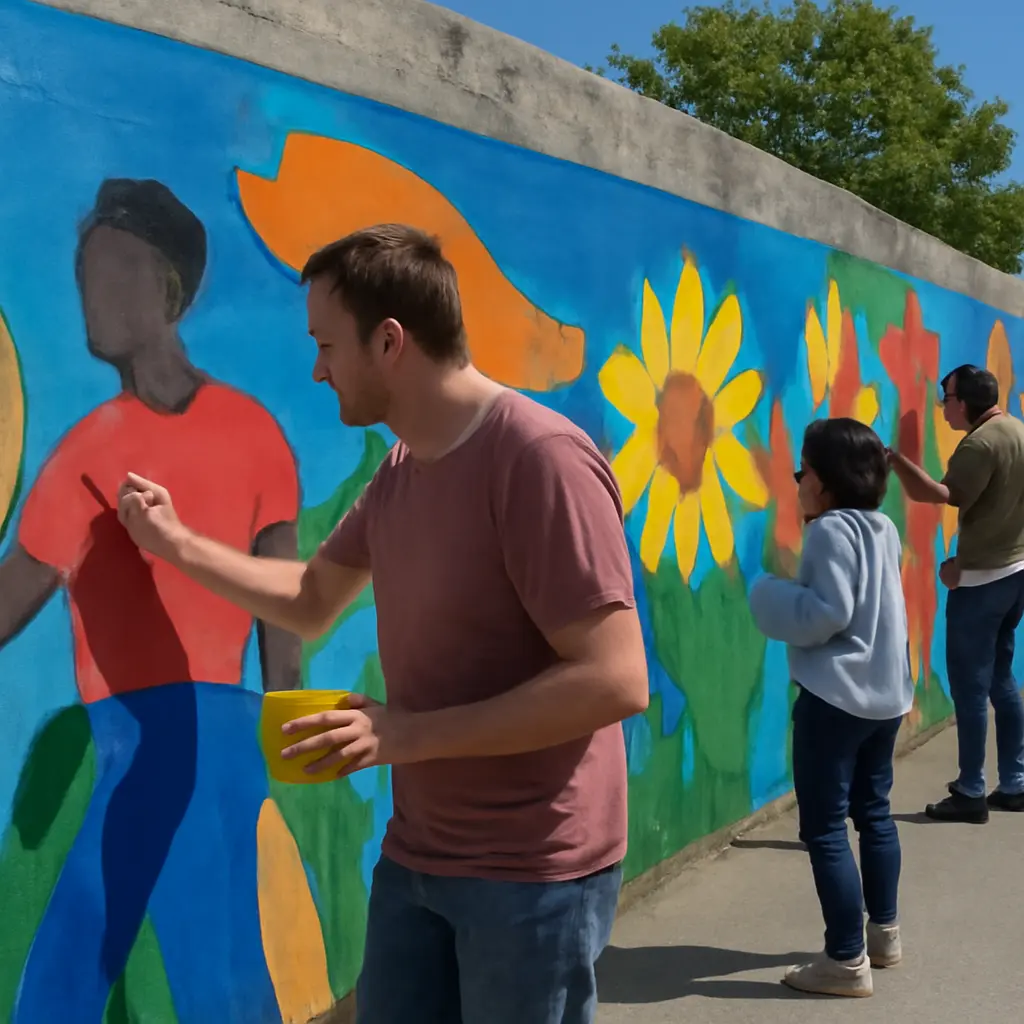
Collaborative art projects can help divided neighborhoods build trust when residents share real decision-making, work toward a visible common goal, and stay involved beyond a single event. They are not a substitute for addressing housing, safety, or economic inequities, and the evidence does not show that art automatically resolves conflict. But research on social cohesion and community arts, together with examples such as Philadelphia’s Mural Arts program, suggests that thoughtfully designed projects can create repeated opportunities for neighbors to meet, express local identity, and cooperate. This article explains what collaborative art means in this context, how its main forms can support trust, what the evidence can—and cannot—establish, and how communities can design projects responsibly.
Collaborative art projects build neighborhood trust through shared participation
A collaborative art project is a creative activity in which community members help shape, make, or present an artwork rather than simply viewing work produced for them. In a divided neighborhood, the process matters as much as the finished mural, performance, garden, or exhibition: residents who might otherwise have little contact can exchange stories, negotiate choices, and complete something together. The National Endowment for the Arts has described arts participation as a potential contributor to civic engagement and community vitality, while community-development research emphasizes that trust is built through repeated, meaningful interaction—not through a single symbolic gesture.
The scale of the challenge makes this relevant. The U.S. Surgeon General’s 2023 advisory reported that, before the COVID-19 pandemic, about half of U.S. adults said they experienced loneliness; loneliness is not the same as neighborhood division, but it underscores the importance of opportunities for connection. The National Academies has likewise noted that social isolation and loneliness are associated with serious health risks. Art projects can provide a practical setting for contact, but their effects depend on who participates, who has authority, and whether the work is sustained.
Shared authorship is the core attribute of collaborative neighborhood art
“Collaborative art” has no single universally binding definition. In community-arts practice, it generally means that people who are not solely professional artists participate in developing the concept, making decisions, creating the work, or presenting it. The important distinction is shared authorship: residents are contributors with influence, not merely an audience or a source of stories for someone else’s project.
This attribute connects art-making to social cohesion—the relationships, shared expectations, and capacity for cooperation that help people live together. The World Bank’s social-capital framework describes social capital in terms of networks, shared norms, and trust that facilitate coordination and cooperation. Applied to neighborhood art, the framework suggests three useful design questions: Do residents meet across social boundaries? Do they have a meaningful say? Do they gain experience cooperating on a shared task?
Participatory art: residents shape the work
Participatory art is work made with active input from participants, who may influence the theme, materials, design, or presentation. A project becomes more genuinely participatory when residents can change the plan, not simply approve a decision already made. For example, a neighborhood mural process might begin with listening sessions, invite competing ideas, and use a resident-led committee to make final design choices.
This distinction matters for trust. A study or evaluation that records attendance alone cannot establish whether people felt respected or shared authority. Organizers can assess participation more meaningfully by documenting who proposed ideas, whose suggestions were adopted, who controlled the budget, and whether participants from different groups returned for later sessions.
Co-created public art: shared decisions become visible
Co-created public art is developed by artists and community members through an ongoing process of consultation, making, and revision. It can include murals, mosaics, installations, and temporary street works. Because the result is visible in a shared place, it can give residents a common reference point and signal that local knowledge has a place in public space.
However, a public artwork is not automatically evidence of public consent. The Project for Public Spaces, a nonprofit focused on placemaking, emphasizes that successful public places respond to the people who use them. In practice, this means asking who uses the site, who may feel excluded, how the work will be maintained, and whether the artwork is connected to broader community priorities.
Community-based arts: creative work is linked to local life
Community-based arts refers to creative activity rooted in a particular community’s interests, histories, and relationships. Its forms include oral-history projects, neighborhood photography, community theater, music workshops, and intergenerational craft. These approaches can help residents share experiences without requiring everyone to agree on a single account of the neighborhood.
That is especially important where residents have different histories or unequal power. A process that makes room for disagreement can build more credible relationships than one that presents an artificial story of harmony. The bridge from shared authorship to trust is therefore not simply “make something together”; it is “make something together under conditions where people are heard and can influence the outcome.”
Repeated creative contact can support trust, but evidence has limits
Trust is a belief that others, or institutions, will act with reliability and fairness. A collaborative art project may support interpersonal trust by creating repeated, low-stakes contact and giving participants a reason to depend on one another. It may also support institutional trust when organizers communicate openly, keep commitments, and share resources fairly. These outcomes are related but distinct: neighbors may enjoy a workshop without changing their views of local institutions.
The evidence is promising but should be interpreted carefully. The National Endowment for the Arts’ 2017 publication, The Arts and Human Development, reviews research linking arts engagement with outcomes such as social connection and community participation, while also recognizing limits in the evidence base. Many community-arts evaluations are local case studies rather than randomized comparisons. They can document participant experiences and project outcomes, but they usually cannot prove that art alone caused broader changes in trust, crime, or neighborhood cohesion.
Repeated contact creates opportunities for cooperation
Repeated contact means participants encounter one another over multiple sessions rather than meeting only at a launch or festival. A series of workshops gives people time to learn names, exchange skills, negotiate disagreements, and see whether others follow through. Those experiences can make cooperation more familiar and reduce reliance on assumptions about people from another group.
The U.S. Surgeon General’s advisory on social connection recommends strengthening community infrastructure and opportunities for social interaction. A neighborhood art program is one possible setting for such interaction, but participation should be accessible: free or low-cost sessions, translation, disability access, childcare, and convenient hours can affect who is able to attend and return.
Shared tasks can create bridging social ties
Bridging social ties connect people across differences such as age, ethnicity, income, tenure, or language; bonding ties strengthen relationships within a group. Divided neighborhoods often need both. A project that serves only one established network may strengthen bonding while leaving boundaries intact. Mixed teams, shared meals, rotating roles, and opportunities to work across groups can encourage bridging connections.
Researchers should not treat diversity in a participant list as proof of meaningful connection. Better indicators include whether participants collaborate across groups, whether they exchange contact information or resources, and whether partnerships continue after the project. These measures help distinguish a one-time gathering from a relationship-building process.
A visible outcome can reinforce local identity
A finished artwork can make collective effort tangible. A mural or public installation may communicate local history, celebrate cultural knowledge, or mark a place as cared for. The artwork can also prompt conversations among people who did not take part in making it, extending its reach beyond the original group.
Yet visibility has risks. A project can unintentionally erase contested histories, use cultural symbols without permission, or become part of redevelopment that displaces the residents it celebrates. The National Endowment for the Arts’ research on creative placemaking has emphasized the importance of community partnerships and local context. Organizers should therefore pair artistic ambition with transparent discussion about ownership, maintenance, consent, and neighborhood change.
Neighborhood art projects work best when power and access are addressed
A well-designed project treats participation as a relationship, not a recruitment tactic. Residents should know who is funding the work, what decisions are open, how their contributions will be credited, and what happens after completion. These conditions are especially important when a neighborhood has experienced neglect, displacement, or broken promises from public agencies.
Resident leadership and fair compensation
Resident leadership means local participants have formal influence over goals, spending, selection of artists, and evaluation. Paying community advisors and artists recognizes that cultural knowledge and organizing labor have value. If a project relies on unpaid participation while outside organizations retain control and credit, it may reproduce the very power imbalances it intends to address.
A practical model is a resident steering group with a published decision-making process, a modest budget authority, and regular opportunities to revise the project. The group can also identify whose voices are missing and offer targeted ways to participate without pressuring anyone to disclose personal experiences.
Cultural safety, consent, and disagreement
Cultural safety means participants can contribute without being demeaned, stereotyped, or expected to represent an entire community. Consent is particularly important in projects involving photographs, oral histories, trauma, or identifiable personal stories. Participants should understand where material will appear, how long it will be used, and whether they can withdraw it.
Facilitators should also plan for disagreement. Shared art does not require a consensus on every neighborhood issue. Clear ground rules, skilled mediation, and the option to contribute anonymously can help participants express different views while keeping the process respectful.
Long-term care and anti-displacement safeguards
Long-term care includes maintenance, documentation, and a plan for what happens when an artwork is damaged, removed, or repurposed. Anti-displacement safeguards recognize that cultural improvements can increase attention to a place without ensuring existing residents benefit. Art should not be presented as a replacement for affordable housing, public services, or meaningful local investment.
The National Endowment for the Arts’ creative placemaking framework encourages partnerships across arts, community development, and other sectors. That cross-sector approach is useful because neighborhood trust is shaped by conditions beyond the arts: housing security, safety, transportation, and access to public space all influence whether residents can participate and remain in place.
Real-world examples show both promise and practical lessons
Philadelphia Mural Arts: large-scale public art and civic participation
Philadelphia Mural Arts began as the city’s anti-graffiti initiative in 1984 and developed into a major public-art organization. Its projects have involved artists, residents, schools, and community organizations in creating murals and related programs. The example shows how a citywide arts initiative can provide a platform for neighborhood stories and participation. It also illustrates why evaluation should distinguish the number of artworks produced from evidence of lasting changes in trust or social conditions.
The transferable lesson is not that murals solve neighborhood conflict. It is that sustained programs can create repeated opportunities for residents and institutions to work together, provided local participants influence the process and projects respond to the setting rather than imposing a generic design.
Creative placemaking: connecting arts with community development
Creative placemaking integrates arts and culture into community planning and development. The National Endowment for the Arts has supported this approach through initiatives such as Our Town, which funds partnerships among arts organizations, local governments, and community partners. These collaborations can connect creative work to public space, local planning, and economic development.
The approach is most relevant to divided neighborhoods when residents help define what improvement means. A successful-looking public space is not enough if it excludes existing users or contributes to displacement. Community-defined goals and transparent measures help keep creative placemaking accountable to residents.
Evaluation should measure relationships as well as artworks
Project evaluation asks whether an initiative reached its goals and for whom. Counting murals, workshop attendance, or event visitors is useful, but those measures do not show whether trust changed. A stronger evaluation combines participation data with resident feedback and evidence of ongoing cooperation.
- Track who participates, returns, leads, and receives compensation, while protecting personal information.
- Ask participants before and after the project whether they feel heard, respected, and able to work with people outside their usual networks.
- Document whether residents’ proposals influenced decisions and whether commitments were completed.
- Check whether new relationships or partnerships continue several months after the final event.
- Report limitations openly; a small local evaluation cannot establish that art alone caused changes in neighborhood-wide trust.
A useful visual for reporting would be a simple chart comparing participation, perceived voice, cross-group collaboration, and follow-up activity at the beginning and end of a project. Such a chart should include the number of respondents and note who may not have been represented, rather than presenting a percentage without context.
Conclusion: collaborative art can create conditions for neighborhood trust
Collaborative art projects can help divided neighborhoods build trust by supporting shared authorship, repeated contact, cross-group cooperation, and visible expressions of local identity. Participatory art, co-created public art, and community-based arts offer different ways to put those principles into practice. The strongest projects give residents real authority, make participation accessible, protect consent, compensate local expertise, and plan for maintenance and displacement risks.
The evidence supports cautious optimism, not a promise that art alone will heal divisions. Organizers, funders, and local governments should treat art as one part of wider community-building work, evaluate relationship outcomes as well as finished products, and remain accountable to the people who live in the neighborhood. Residents considering a project can begin with listening sessions, a resident-led decision group, and a clear plan for how the work will serve the community after the unveiling.
Sources: U.S. Department of Health and Human Services, Our Epidemic of Loneliness and Isolation: The U.S. Surgeon General’s Advisory on the Healing Effects of Social Connection and Community, 2023, https://www.hhs.gov/sites/default/files/surgeon-general-social-connection-advisory.pdf; National Academies of Sciences, Engineering, and Medicine, Social Isolation and Loneliness in Older Adults: Opportunities for the Health Care System, 2020, https://nap.nationalacademies.org/catalog/25663/social-isolation-and-loneliness-in-older-adults-opportunities-for-the; National Endowment for the Arts, The Arts and Human Development: Framing a National Research Agenda for the Arts, Lifelong Learning, and Individual Well-Being, 2017, https://www.arts.gov/impact/research/publications/arts-and-human-development-framing-national-research-agenda-arts; World Bank, Social Capital Initiative Working Paper No. 1: The Initiative on Defining, Monitoring and Measuring Social Capital, 1998, https://documents.worldbank.org/en/publication/documents-reports/documentdetail/965231468740974231/social-capital-initiative-working-paper-no-1-the-initiative-on-defining-monitoring-and-measuring-social-capital; Project for Public Spaces, What Is Placemaking?, https://www.pps.org/article/what-is-placemaking; National Endowment for the Arts, Our Town, https://www.arts.gov/grants/our-town; Mural Arts Philadelphia, About Mural Arts Philadelphia, https://www.muralarts.org/about/.