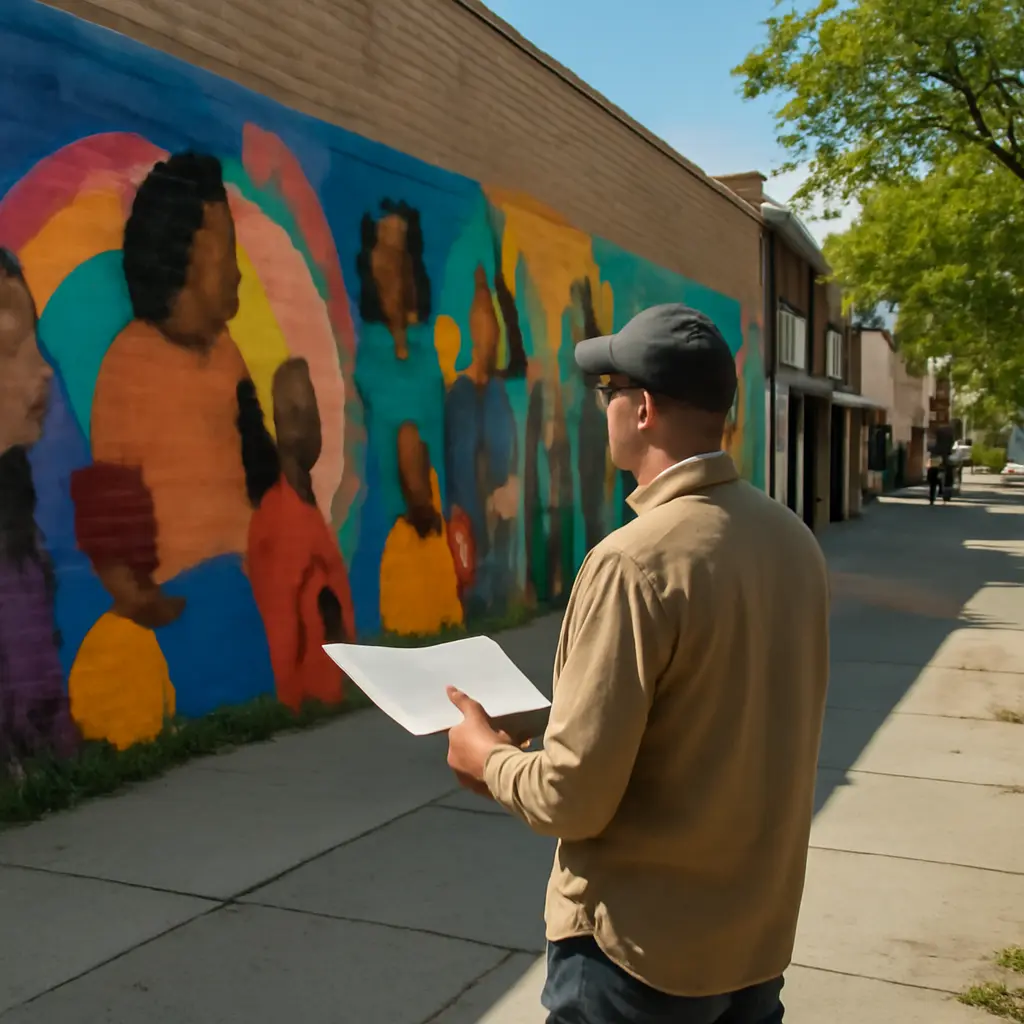
Forgotten geographies are places whose histories and communities have been obscured by neglect, displacement, redevelopment, or dominant public narratives. Artists restore memory to these locations through murals, monuments, archival projects, performance, and community-led memorials—not simply by marking a spot, but by making its layered stories visible and discussable. Examples from Tulsa’s Greenwood District, New York’s Lower East Side, and Cape Town’s District Six show how this work can reconnect place with people and history, while also raising questions about who controls remembrance and whose stories receive public space.
How artists restore memory to forgotten geographies
“Forgotten geography” is a useful descriptive term rather than a single formal category in art history. It refers to places whose cultural or historical significance has been erased, minimized, or made difficult to encounter. The National Park Service’s work on historic preservation, for example, emphasizes that places can communicate cultural significance through their physical features and their associations with communities and events. Artists build on that principle by using art to connect visible sites with histories that official markers, redevelopment plans, or public memory have left out.
This work matters because physical change can remove the evidence through which a community recognizes its past. The United Nations estimates that more than half of the world’s population lives in urban areas, a share projected to approach 70 percent by 2050. As cities grow and redevelop, art can provide a public means of documenting histories of migration, racial violence, labor, environmental change, and displacement. The approaches range from permanent memorials to temporary installations and digital archives; each balances visibility, participation, preservation, and the risk of turning painful history into spectacle.
Public art as a practice of geographic memory
Public-memory art can be defined as creative work situated in, or connected to, a place that interprets its past for people in the present. Art historian and memory-studies scholar James E. Young has examined how memorials shape public memory, arguing that monuments are not neutral containers of history: their forms and meanings are created through choices about what to commemorate and how. This perspective helps explain why artists restoring overlooked locations often work with residents, local historians, and archives rather than treating a site as an empty canvas.
Related forms include counter-monuments that question conventional heroic memorials, site-specific installations that respond to local histories, community murals, walking tours, oral-history projects, and digital mapping. These practices share a geographic focus, but differ in duration and authority: a permanent sculpture may create a lasting landmark, while a participatory archive can preserve many voices without claiming to tell a final story. The following approaches show how those differences shape restoration.
Site-specific memorials and counter-monuments
A site-specific memorial is an artwork designed in relation to the history, landscape, or use of a particular place. A counter-monument, in Young’s account, resists the idea that a single imposing object can settle public memory. Instead, it may invite participation, emphasize absence, or leave interpretation open. These approaches are especially relevant where the historic site has been demolished or transformed: the artwork can acknowledge what is missing without pretending that an object fully replaces it.
The National Memorial for Peace and Justice in Montgomery, Alabama, offers a major example of place-based commemoration. Opened in 2018 by the Equal Justice Initiative, it memorializes thousands of Black people killed by racial terror lynching in the United States. Its suspended steel monuments and associated memorial space make the history physically present while directing visitors toward the broader geography of racial violence. The project’s scale—more than 800 suspended steel monuments, representing counties where documented lynchings occurred—shows how an artwork can link one location to a national history.
Community murals and neighborhood memory
Community murals are public paintings created with, or in dialogue with, the people who live in a place. They can preserve neighborhood landmarks, honor local figures, and make histories visible in everyday settings. Their value is not only visual: collaborative planning can give residents a role in deciding what is represented. At the same time, a mural’s presence does not automatically prevent displacement or guarantee community control; ownership, maintenance, and the politics of redevelopment remain important.
In New York City, the Lower East Side has a long history of murals and public art shaped by immigrant communities, activism, and neighborhood change. The Lower East Side History Project documents the area’s successive communities and the pressures that have altered its built environment. Such projects complement street-level art by connecting images and sites to records, testimony, and historical context. Together, murals and local documentation help residents and visitors understand that a neighborhood is not simply a backdrop but a record of changing lives.
Oral histories, archives, and walking routes
Oral-history and archival art practices preserve memory through recorded testimony, photographs, documents, sound, and guided routes. They are particularly useful when redevelopment has erased buildings or when a history was excluded from official records. A walking tour can reconnect scattered locations, while a digital map can link photographs and interviews to places that no longer look as they once did. These formats also allow artists to present multiple perspectives rather than concentrating meaning in a single monument.
Cape Town’s District Six Museum demonstrates how community memory can be assembled around a place transformed by forced removal. Under apartheid, District Six was declared a white area in 1966, and tens of thousands of residents were forcibly removed; the museum records the neighborhood’s history through personal accounts, photographs, maps, and objects. Its approach shows why archives can function as a form of public art and civic interpretation: they preserve residents’ relationships to streets and homes even when the original urban fabric has been disrupted.
How art brings overlooked histories into public view
The methods above become most powerful when they connect a specific location to a larger historical pattern. In Tulsa, the Greenwood District—once a prosperous Black commercial community known as “Black Wall Street”—was devastated during the 1921 Tulsa Race Massacre. The Tulsa Race Massacre Centennial Commission and local institutions have supported public interpretation, historical education, and memorial initiatives that make the violence and its aftermath more visible. The case illustrates that restoration is not only about commemorating an event; it also involves documenting destroyed property, interrupted lives, and the continuing effects of exclusion.
Artists and cultural organizations can also use maps, projections, and temporary installations to reveal histories hidden beneath present-day streets. In New York, the “Here Lies Love” project by artist and activist groups has used site-based performance and public programming to engage histories of Filipino migration and labor, while many neighborhood projects use archival images to show how familiar streets have changed. Such work can help audiences notice layers of history, but interpretation should be grounded in reliable sources and developed with people connected to the place.
Ethics, participation, and the limits of artistic repair
Restorative art must confront the question of who has the authority to tell a place’s story. Community consultation is not a decorative step: it can determine which memories are represented, how sensitive material is handled, and whether residents can challenge or revise the interpretation. The International Coalition of Sites of Conscience, a global network of historic sites and museums, promotes approaches that connect past struggles with contemporary questions and encourage public dialogue. Its model reinforces the value of interpretation that is participatory rather than purely commemorative.
Artists should also distinguish remembrance from repair. A mural or memorial can make injustice visible, but it cannot by itself return land, compensate families, restore demolished housing, or resolve disputes over development. Public artworks may even contribute to cultural branding that raises property values and accelerates displacement. Responsible projects therefore consider long-term stewardship, access, credit and compensation for contributors, historical accuracy, and whether the people whose histories are represented can continue to shape the site.
Conclusion: restoring place without claiming to erase the past
Artists restore memory to overlooked locations through site-specific memorials, counter-monuments, community murals, oral histories, archives, and walking routes. The National Memorial for Peace and Justice, the District Six Museum, and projects documenting Tulsa’s Greenwood District demonstrate how these forms can connect a particular place to histories that might otherwise remain obscured. Their shared lesson is that public art can make memory visible, but its credibility depends on research, community participation, and continued care.
To support this work, visit local historical sites, listen to community organizations, consult archives, and ask who is represented—and who is missing—in public spaces. Further reading from the National Park Service, the Equal Justice Initiative, the District Six Museum, and the International Coalition of Sites of Conscience can help readers explore how memory, place, and justice intersect.
Sources: National Park Service, National Register Bulletin: How to Apply the National Register Criteria for Evaluation, https://www.nps.gov/subjects/nationalregister/upload/NRB-15_web508.pdf; James E. Young, The Texture of Memory: Holocaust Memorials and Meaning, Yale University Press, https://yalebooks.yale.edu/book/9780300059915/the-texture-of-memory/; Equal Justice Initiative, National Memorial for Peace and Justice, https://eji.org/projects/national-memorial-for-peace-and-justice/; Lower East Side History Project, About the Lower East Side, https://www.lowereasthistory.com/; District Six Museum, About District Six, https://districtsix.co.za/; Tulsa Race Massacre Centennial Commission, Tulsa Race Massacre, https://www.tulsa2021.org/; International Coalition of Sites of Conscience, About Us, https://www.sitesofconscience.org/about-us/; United Nations Department of Economic and Social Affairs, 68% of the world population projected to live in urban areas by 2050, https://www.un.org/development/desa/en/news/population/2018-revision-of-world-urbanization-prospects.html