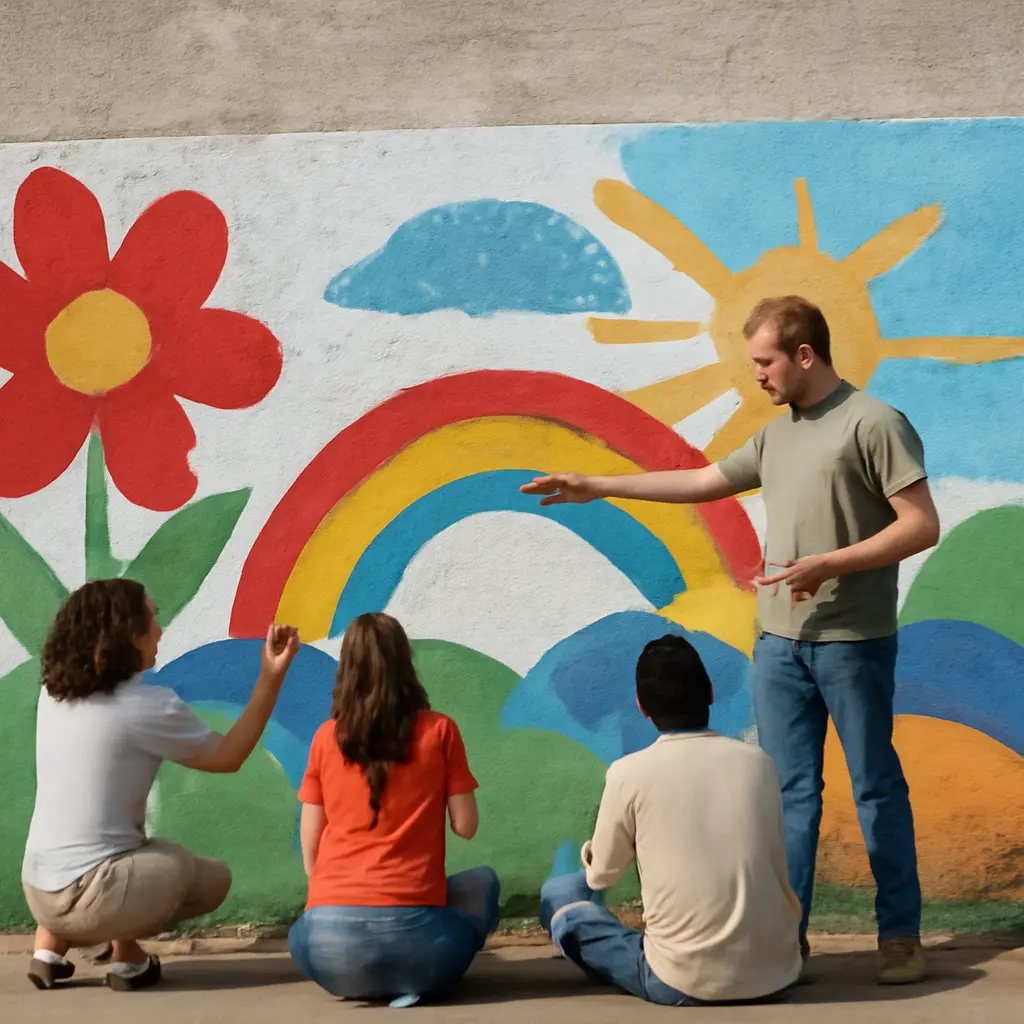
Street art workshops—guided, hands-on sessions where people create visual art in public or community settings—may help participants begin experimenting sooner than conventional, instructor-led art classes. Their emphasis on making, collaboration, and real-world surroundings can reduce the distance between learning an idea and trying it. Research supports the value of active arts participation and informal learning, but direct studies comparing street art workshops with traditional classes are limited; the strongest case is that these workshops offer conditions that can encourage rapid creative engagement, not that they guarantee faster creativity for everyone.
How street art workshop design supports creative engagement
A street art workshop is a structured learning activity in which participants explore visual techniques—such as lettering, stencil work, illustration, or mural painting—often in a shared, community-based setting. The National Endowment for the Arts describes arts participation as including active forms such as making and performing, while educational research on active learning distinguishes participation and practice from simply receiving information. Together, these ideas help explain why a workshop can prompt people to start creating quickly: learners handle materials, make choices, and receive feedback as they work.
The setting matters, too. Public walls, community spaces, and collaborative projects provide a visible purpose for the work, while a short demonstration can be followed immediately by experimentation. These features align with experiential learning, in which learners build understanding through action and reflection. They do not prove that street art instruction is inherently superior to classroom teaching; rather, they identify practical mechanisms that may make early participation more likely.
Hands-on practice and rapid experimentation
Hands-on practice means learning by trying a technique rather than only hearing or reading about it. In a workshop, a participant might test a stencil, adjust a letterform, and revise a color choice within minutes. Freeman and colleagues’ 2014 meta-analysis of undergraduate science education found that active learning improved examination performance and that students in traditional lecture courses were more likely to fail. Although that research concerns science courses—not street art—it provides evidence for the broader instructional principle that active participation can improve learning outcomes.
For street art, experimentation can be especially accessible because a first attempt does not need to be polished. Facilitators can offer a short skill demonstration, then invite participants to make a small draft or test panel. This sequence turns an abstract instruction into an immediate choice: try, observe, and change. The benefit is strongest when the activity is appropriately scaffolded, with safe tools, clear boundaries, and options for different levels of experience.
Choice, ownership, and creative confidence
Creative ownership is the sense that a learner’s ideas and decisions shape the finished work. Street art workshops can support ownership by letting participants select a theme, image, color palette, or message while learning a shared set of techniques. The National Core Arts Standards emphasize creating, presenting, responding, and connecting as distinct but related artistic processes. A workshop that includes both making and discussion can therefore connect technical practice with personal interpretation.
Choice alone does not ensure confidence or creativity. New learners may need examples, prompts, or a limited set of materials to avoid feeling overwhelmed. A useful design balances structure with freedom: the instructor teaches a technique, participants adapt it, and feedback focuses on decisions and revision rather than ranking people by talent.
Why street art workshops can feel faster than traditional classes
The perceived speed of a workshop often comes from its format. A conventional class may devote substantial time to demonstrations, theory, or sequential skill exercises before students produce a finished piece. A street art workshop can compress instruction and practice into one session, giving participants a visible outcome sooner. This is a difference in learning design and pacing, not evidence that the workshop necessarily produces deeper or more lasting mastery.
Short feedback loops and visible progress
A feedback loop is the cycle of trying something, seeing its effect, and adjusting. In mural or stencil activities, the result is visible immediately, allowing a facilitator or peer to suggest a practical next step. The National Academies’ work on how people learn describes the importance of connecting new knowledge to what learners already understand and using feedback to support improvement. In this context, a participant can compare an initial sketch with a test print, then revise scale, spacing, or contrast.
Visible progress can make a short activity feel rewarding, but a finished-looking piece is not the same as mastery. Traditional classes may provide more time for drawing fundamentals, art history, composition, and repeated practice. The strongest workshop model uses its quick start as an entry point and points learners toward further instruction when they want to develop technical depth.
Collaboration and peer learning
Peer learning occurs when participants exchange ideas, observe one another’s methods, or contribute to a shared result. A group mural creates natural opportunities to negotiate a theme, divide tasks, and combine different visual approaches. The National Endowment for the Arts’ research on arts participation documents the reach of arts engagement in U.S. communities, though participation data should not be mistaken for proof that a particular workshop format causes faster creativity.
Collaboration can broaden the range of ideas available to a group, but it also requires thoughtful facilitation. Clear roles, consent around public display, and ways for quieter participants to contribute help prevent a shared project from being dominated by only a few voices.
Community relevance and learning beyond the studio
Community relevance means connecting an artwork to the people, stories, or place around it. A neighborhood mural may invite participants to research local history, discuss representation, and consider how public images affect shared space. UNESCO’s culture and arts education framework treats arts learning as connected to cultural participation and expression, supporting the idea that art education can extend beyond technical instruction.
Public work also introduces responsibilities that may be absent from a standard studio exercise. Organizers need permission from property owners or relevant authorities, appropriate supervision, and safe materials. When those conditions are met, a public-facing project can give learners a meaningful audience and a concrete reason to consider how their choices communicate.
Street art workshop formats and practical examples
Street art workshops include several related formats rather than one fixed method. Their shared feature is guided participation in visual making, while their tools, duration, and public visibility vary. Choosing a format depends on participants’ ages and experience, the available site, the project’s purpose, and local safety rules.
Stencil and paste-up workshops
Stencil workshops teach participants to cut or use prepared shapes to create repeated images, while paste-up activities focus on assembling and displaying paper-based designs where permitted. Both can lower the technical barrier to making a bold graphic composition. A facilitator can introduce contrast, negative space, and repetition, then have participants test designs on paper before any public presentation.
These formats work well for short sessions because participants can produce a clear visual result with relatively few tools. Organizers should account for cutting-tool safety, ventilation where relevant, disposal, and permission for any display surface.
Collaborative mural projects
A collaborative mural is a large-scale work created by several artists or participants, often around a shared theme. It can combine drawing, color planning, lettering, and teamwork. A practical example is a youth program that begins with a discussion of neighborhood stories, develops individual sketches, and then combines selected motifs into a wall design with the site owner’s approval.
This process can make creative work socially meaningful, but a mural’s scale may conceal unequal participation unless roles are planned carefully. Facilitators can invite contributions at several stages—idea generation, sketching, color testing, painting, and reflection—so that participants with different skills have meaningful ways to take part.
Measuring whether a workshop sparks creativity
“Faster creativity” is not a standard research measure. It can be assessed more carefully by defining observable indicators, such as time to begin a first draft, number of distinct ideas generated, willingness to revise, or participant-reported confidence before and after the session. These measures capture different outcomes and should not be treated as interchangeable.
A simple evaluation might record how long participants take to begin making, collect anonymous reflections, and compare initial sketches with revised versions. To establish whether a workshop outperforms a traditional class, researchers would need comparable groups, clear definitions of creativity, and follow-up measures. Because the available evidence cited here concerns active learning and arts participation more broadly, claims of a proven street-art-specific speed advantage should remain cautious.
Conclusion: street art workshops as a creative starting point
Street art workshops can encourage early creative engagement by combining hands-on experimentation, participant choice, short feedback loops, collaboration, and community relevance. Evidence from active-learning research supports the value of participation, while arts-education frameworks emphasize creating and connecting. However, direct comparisons showing that street art workshops make people creative faster than traditional classes remain limited, and rapid output should not be confused with lasting skill.
For educators and organizers, the practical next step is to design workshops with a quick, welcoming first activity, meaningful participant choice, inclusive collaboration, and clear safety and permission practices. Track what participants actually do and learn rather than relying on the appeal of a finished mural alone. Further reading on active learning, arts education, and community-based art can help programs build both an energizing first experience and a path toward deeper practice.
Sources: National Endowment for the Arts, Arts Participation Patterns in the United States, https://www.arts.gov/impact/research/arts-data-profile-series; Freeman et al., “Active learning increases student performance in science, engineering, and mathematics,” Proceedings of the National Academy of Sciences, 2014, https://doi.org/10.1073/pnas.1319030111; National Core Arts Standards, Artistic Processes, https://www.nationalartsstandards.org/; National Academies of Sciences, Engineering, and Medicine, How People Learn II: Learners, Contexts, and Cultures, 2018, https://doi.org/10.17226/24783; UNESCO, Framework for Culture and Arts Education, 2024, https://www.unesco.org/en/culture-education/framework