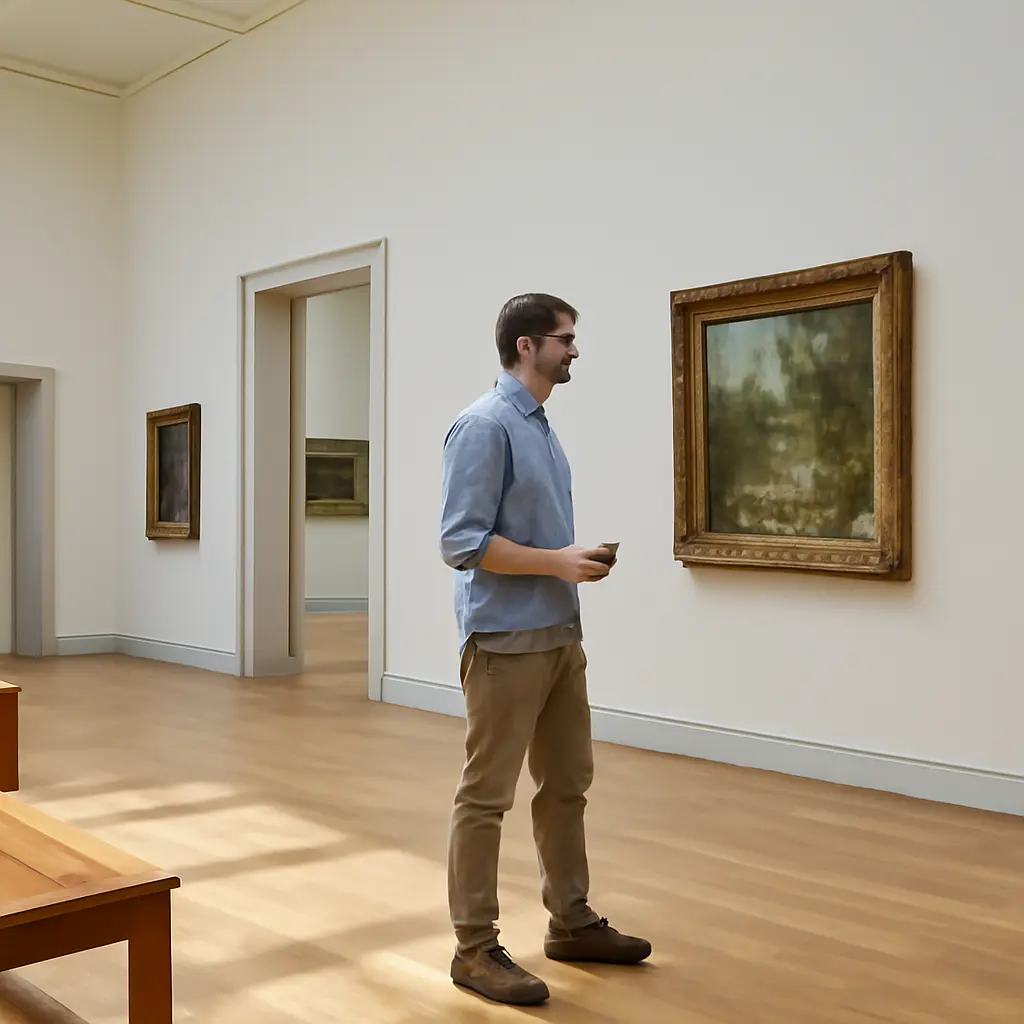
Getting lost in an art gallery can be good for your brain—not because confusion is automatically beneficial, but because wandering, choosing what to look at, and interpreting unfamiliar works can encourage curiosity, attention, reflection, and conversation. Research on museums and the arts links cultural participation with learning and wellbeing, while studies of how people navigate galleries show that visitors often create their own paths rather than follow a fixed sequence. The evidence supports a measured conclusion: a gallery visit may offer cognitive and emotional benefits, but it does not prove that literally getting lost improves intelligence or prevents cognitive decline.
Gallery wandering and cognitive engagement
Gallery wandering is the self-directed movement through an exhibition, involving choices about where to go, what to attend to, and how long to look. It is different from aimless confusion: the visitor remains in a setting rich with visual cues, objects, and possible interpretations. In research on museum learning, this kind of exploration is often understood as an interaction between the visitor, the physical environment, and the artworks—not as a single mental exercise with one guaranteed outcome.
That distinction matters because the popular claim that getting lost is “good for your brain” can overstate the evidence. Research does suggest that engaging with art and cultural settings can support reflection, learning, and wellbeing. It does not establish that wandering through a gallery by itself produces lasting gains in memory, creativity, or general intelligence.
Self-directed looking and attention
Self-directed looking means choosing what to notice rather than receiving every detail in a prescribed order. A visitor might pause over a painting, compare it with another, or return to an earlier room. Those choices can exercise attention and visual comparison in the everyday sense: the person is selecting and revisiting information. They should not be confused with evidence that a gallery visit functions like a clinical cognitive-training program.
Museum studies have long described visitors as active meaning-makers. The influential contextual model of learning developed by John H. Falk and Lynn D. Dierking treats museum experience as shaped by personal interests, social interaction, and the exhibition’s physical setting. Their framework helps explain why the same artwork or route may prompt different experiences for different people.
Navigation, choice, and manageable uncertainty
A gallery’s rooms, signs, sightlines, and exhibits form a navigation environment. Visitors make small decisions as they move through it: follow a doorway, turn toward a striking object, or pause when something catches the eye. This can create a mild sense of uncertainty while keeping the experience bounded and safe. It is more accurate to describe this as exploratory choice than to claim that disorientation itself benefits the brain.
Visitor research also cautions against assuming that everyone follows the curator’s intended route. In observational studies of museum movement, people commonly make individual paths and vary the time they spend at different objects. A floor plan or visitor-tracking chart could illustrate this pattern: routes often branch, loop, and converge rather than forming one orderly line.
Art interpretation and the benefits of ambiguity
Art interpretation is the process of making sense of an artwork through observation, knowledge, emotion, and conversation. Ambiguous or unfamiliar works may invite visitors to generate explanations instead of simply recognizing a familiar scene. That can make a visit intellectually engaging, though uncertainty is not inherently beneficial: a confusing display without context or access support may frustrate visitors rather than help them learn.
Curiosity and open-ended interpretation
Curiosity can be encouraged when a visitor notices a detail and wonders what it means. Looking closely, proposing an interpretation, and then reconsidering it after reading a label are forms of active engagement. The National Endowment for the Arts has reported associations between arts participation and measures of civic and social engagement, but such findings do not show that a particular gallery experience caused those outcomes.
A practical example is a visitor who first reads a painting as a simple landscape, then notices unusual color or scale and revises that interpretation. The value lies in the process of looking and reconsidering—not in reaching a single “correct” answer. Museum educators can support this by asking open questions such as, “What do you notice?” and “What makes you think that?”
Reflection, emotion, and wellbeing
Art can prompt emotional responses and personal reflection, and a quiet gallery may offer a change of pace from routine. A 2019 World Health Organization scoping review examined more than 3,000 studies on arts and health, finding evidence across a wide range of outcomes and settings. The review covered many kinds of arts activity, however, so it should not be read as proof that wandering in an art gallery alone improves health.
The distinction between association and cause is important. People who visit museums may differ from those who do not in health, income, education, mobility, or access to cultural institutions. Studies that find links between cultural participation and wellbeing cannot automatically separate the effects of the visit from these other factors.
Social looking and learning in galleries
Gallery visits are often social experiences. Friends, families, school groups, and guided-tour participants can compare observations and explain what they see to one another. Conversation may add perspectives that a solitary visitor would not encounter, while quiet individual looking can also be valuable. The benefit depends on the visitor, the exhibition, and the kind of interaction—not on one ideal way to experience art.
Conversation as shared interpretation
Shared interpretation happens when visitors discuss an artwork and build or revise ideas together. One person may notice a figure in the background; another may connect the image to a historical event. Such exchanges make the visit more than a sequence of objects and can help people articulate their reasoning. They are especially useful when conversation remains open rather than turning into a quiz with one expected answer.
The National Gallery of Art and other museums use discussion-based approaches in education programs, including close-looking activities that invite participants to describe evidence before interpreting it. These practices reflect a broader educational principle: observation and explanation can reinforce each other. They do not mean that every visitor must talk; accessible museum design should also accommodate people who prefer to explore silently.
Access, comfort, and meaningful exploration
A positive wandering experience depends on whether visitors can navigate comfortably. Clear wayfinding, seating, accessible routes, readable labels, sensory information, and staff support can make exploration more inviting. For someone with fatigue, a mobility limitation, low vision, sensory sensitivity, or anxiety, a crowded or confusing layout may create barriers rather than beneficial challenge.
Museums therefore face a useful design balance: preserve opportunities for discovery while making orientation and assistance easy to find. Visitors can help themselves by checking a map, choosing a few areas of interest, taking breaks, and asking staff for directions. Getting turned around is not a requirement for a worthwhile visit.
How to explore a gallery without overstating the science
The most defensible takeaway is that a gallery can provide conditions for attention, curiosity, reflection, and social learning. These are plausible and research-informed benefits of engaging with art, not a promise of measurable brain improvement from every visit. A relaxed, self-directed approach can help visitors make the experience their own.
- Choose one room or artwork that attracts you, even if you cannot explain why.
- Spend time observing details before reading the label, then see whether the information changes your interpretation.
- Allow yourself to take an unexpected route, but use a map or ask for help whenever you want.
- Pause, sit down, or leave a room if you feel tired or overwhelmed.
- If visiting with others, trade observations without assuming that everyone should interpret a work the same way.
A simple visitor-experience graphic could compare a fixed, guided route with a self-directed route, showing how each can include close looking, pauses, and conversation. The point would not be that one route is scientifically superior, but that different approaches can support different needs and interests.
Conclusion: gallery exploration can invite a more active mind
Gallery wandering combines self-directed attention, navigation, interpretation, reflection, and sometimes social conversation. Research on museum learning and arts participation provides reasons to value these experiences, while also setting limits on what can be claimed: evidence does not show that getting lost in a gallery directly boosts intelligence or prevents cognitive decline. Treat the museum as an opportunity for curiosity rather than a brain-training prescription. On your next visit, follow an artwork that interests you, take your time, and ask museum staff for support whenever you need it.
Sources: Falk, John H., and Lynn D. Dierking, The Museum Experience Revisited, 2013, https://www.routledge.com/The-Museum-Experience-Revisited/Falk-Dierking/p/book/9781598741636; World Health Organization Regional Office for Europe, What is the evidence on the role of the arts in improving health and well-being? A scoping review, 2019, https://www.who.int/europe/publications/i/item/9789289054553; National Endowment for the Arts, The Arts and Social Cohesion: An Exploration of the Arts’ Role in Fostering Social Cohesion, 2017, https://www.arts.gov/impact/research/publications/arts-and-social-cohesion-exploration-arts-role-fostering-social-cohesion; National Gallery of Art, Teaching Critical Thinking Skills Through Visual Art, https://www.nga.gov/learn/teachers/lessons-activities/critical-thinking.html