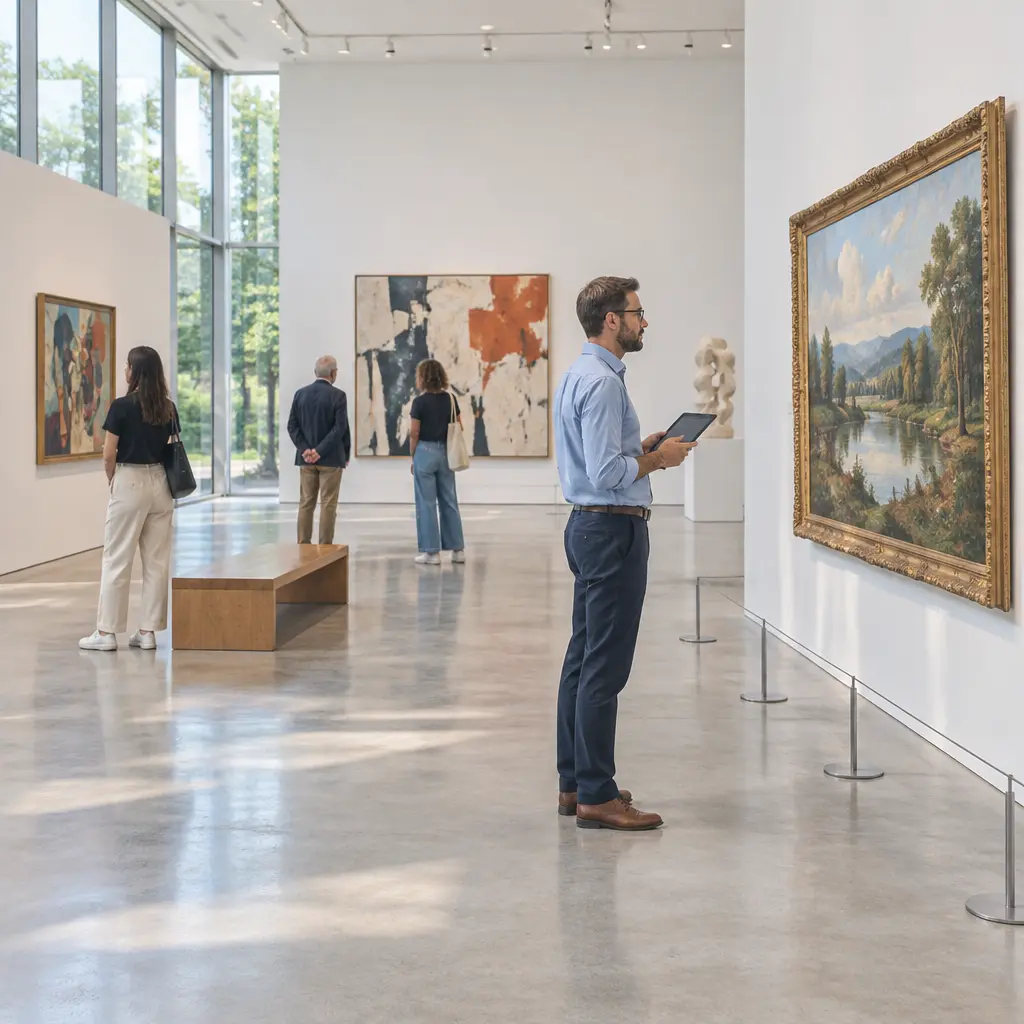
Art galleries and museums are institutions that collect, care for, interpret, and present works of art and other objects to the public. Their future is likely to be hybrid: physical galleries will remain essential for firsthand encounters, while digital tools, inclusive programming, and more sustainable operations will expand who can participate and how. The International Council of Museums’ 2022 museum definition emphasizes accessibility, inclusivity, and community participation; meanwhile, the United Nations Educational, Scientific and Cultural Organization (UNESCO) reported that the pandemic led to the closure of 90% of museums worldwide in 2020, exposing the risks of relying on in-person visits alone. These pressures make digital access, financial resilience, inclusion, and responsible stewardship central to the next era of museums and galleries.
How Hybrid Access Shapes the Future of Art Galleries and Museums
Hybrid access combines visits to physical spaces with digital experiences that help people discover, interpret, and engage with collections remotely. It is not simply a virtual copy of a building: it can include searchable collection databases, online exhibitions, livestreamed events, audio guides, and accessible interpretation. The approach responds to a basic institutional challenge—serving audiences who differ in location, ability, time, language, and familiarity with art.
Digital collections and online exhibitions
A digital collection is an online catalogue of collection records and images; an online exhibition organizes selected works into a curated interpretive experience. These formats can make research and discovery possible beyond museum opening hours and geographic boundaries. The Google Arts & Culture platform, for example, has worked with cultural organizations to provide digital access to artworks and heritage sites. The quality of access depends on more than digitization: clear metadata, high-quality images, rights management, accessible design, and reliable technology all matter. Digital materials should complement—not replace—conservation, scholarship, and the sensory experience of encountering an original work.
Immersive and interactive experiences
Immersive experiences use technologies such as augmented reality, virtual reality, projection, and interactive displays to add layers of interpretation. They may help visitors visualize a historical setting, compare details, or explore an artwork’s context. The Cleveland Museum of Art’s ArtLens Gallery is a prominent example of interactive technology used to connect visitors with collection objects. Such installations can attract new audiences, but institutions should evaluate whether the technology deepens understanding rather than distracts from the art. They also need to plan for equipment maintenance, data privacy, and alternatives for visitors who cannot or do not wish to use digital interfaces.
Accessibility across physical and digital spaces
Accessibility means designing services and environments so people with different abilities can participate meaningfully. In museums, this includes step-free routes, seating, tactile or audio interpretation, captioning, sign-language options, readable websites, and sensory-aware programming. The World Wide Web Consortium’s Web Content Accessibility Guidelines provide an established framework for making digital content more accessible. A hybrid strategy works best when accessibility is built in from the outset: digital interpretation can offer adjustable text and audio, while in-person services provide human guidance and physical access.
How Community Participation Shapes the Future of Art Galleries and Museums
Community participation is the active involvement of audiences and source communities in decisions about interpretation, programming, collections, and institutional priorities. It shifts museums from presenting culture to audiences toward working with them. The International Council of Museums’ 2022 definition describes museums as institutions that are accessible and inclusive and that operate with the participation of communities. This principle is especially important where collections reflect colonial histories, contested ownership, or cultural traditions that museums have historically interpreted without sufficient input from their makers or descendants.
Co-curation and shared authority
Co-curation is a collaborative process in which museum professionals and community participants shape an exhibition or interpretation together. Shared authority recognizes that expertise may come from lived experience, cultural knowledge, and community memory as well as academic research. The National Museum of the American Indian, part of the Smithsonian Institution, has developed community-centered approaches to interpreting Indigenous cultures. These practices can produce richer exhibitions, but meaningful collaboration requires time, compensation, clear decision-making roles, and ongoing relationships rather than consultation added at the end of a project.
Representation, provenance, and repatriation
Representation concerns whose histories and creative work are collected and displayed. Provenance is the documented history of an object’s ownership and movement; repatriation is the return of cultural property or human remains to individuals or communities with a recognized claim. The American Alliance of Museums’ guidance on collections stewardship encourages institutions to research provenance and address ethical responsibilities. The Smithsonian Institution’s National Museum of African American History and Culture, for instance, presents histories shaped by slavery, migration, resistance, and cultural achievement through objects and community-informed interpretation. Transparent research and responsible return processes can strengthen public trust, although each case requires careful legal, historical, and ethical assessment.
Audience development and belonging
Audience development is the sustained work of understanding who visits, who does not, and what barriers prevent participation. It includes affordable admission, multilingual interpretation, partnerships with schools and local organizations, and programming designed with underserved audiences. The American Alliance of Museums’ National Snapshot of United States Museums, published in 2021, documented severe pandemic-era financial and operational pressures, reinforcing the importance of resilient relationships with local communities. Museums can assess progress through repeat visitation, audience surveys, participation in community programs, and evidence that visitor feedback influences institutional decisions.
How Financial Resilience Shapes the Future of Art Galleries and Museums
Financial resilience is an institution’s ability to sustain its mission through changing income, costs, and public conditions. Museums and galleries often combine admission revenue, donations, grants, public funding, memberships, retail, and event income. The pandemic showed how quickly visitor-dependent revenue can disappear: UNESCO reported that museums were closed for an average of 155 days in 2020, while many faced reduced income and staffing. Future planning therefore requires more than recovering visitor numbers; it requires diversified funding and a clear connection between commercial activity and public purpose.
Diversified funding and earned income
Diversified funding reduces dependence on a single source by balancing public grants, philanthropy, memberships, admissions, licensing, and mission-aligned commercial activities. Earned income may come from ticketed programs, venue hire, publishing, or museum shops. The American Alliance of Museums’ pandemic research highlighted the vulnerability of institutions when normal operations and visitor income were interrupted. Diversification does not eliminate risk: institutions must weigh commercial choices against affordability, collections care, and public access, and should maintain contingency plans for unexpected shocks.
Digital revenue and membership
Digital revenue includes income from online courses, virtual events, paid digital content, licensing, and remote memberships. These offerings can extend a museum’s reach, but they require investment in production, marketing, rights clearance, and technology. Membership programs can also provide recurring support and help cultivate long-term relationships, particularly when benefits include both on-site and online experiences. A strong model treats digital products as mission-based services and tests whether they generate sustainable net income rather than assuming that online reach automatically translates into revenue.
Measuring impact and public value
Impact measurement evaluates whether an institution achieves outcomes such as learning, community connection, access, or economic contribution—not only how many people enter the building. The International Council of Museums’ definition places research, education, enjoyment, and community participation among museum responsibilities. Institutions can combine attendance and income data with visitor feedback, school engagement, accessibility assessments, and community-partner evaluations. A balanced dashboard helps leaders explain public value to funders while identifying where programs should change.
How Sustainable Stewardship Shapes the Future of Art Galleries and Museums
Sustainable stewardship is the long-term care of collections, buildings, and institutional resources in ways that reduce environmental harm and preserve cultural value. Museums face a distinctive challenge: collections need stable conditions, but energy-intensive climate control can contribute to emissions. Sustainability therefore involves both environmental management and professional conservation, with decisions tailored to the materials, risks, and significance of each collection.
Climate-conscious buildings and operations
Climate-conscious operations reduce energy use and emissions through measures such as efficient lighting, improved insulation, renewable electricity, and carefully designed heating, ventilation, and air-conditioning systems. The International Energy Agency identifies buildings as a major area for energy efficiency and emissions reduction, making museum facilities relevant to broader climate goals. Because artworks and historic objects can be sensitive to temperature, humidity, and light, museums should assess conservation risks before changing environmental settings. Building audits, energy monitoring, and preventive maintenance can help align collections care with lower-impact operations.
Conservation, collections care, and responsible growth
Collections care includes preventive conservation, documentation, safe storage, and treatment when necessary. It also involves responsible collecting: every acquisition creates long-term obligations for storage, research, insurance, and conservation. The International Council of Museums’ Code of Ethics for Museums emphasizes professional care and responsible management of collections. Institutions can improve sustainability by reviewing storage capacity, sharing expertise and facilities, and making acquisition decisions that account for future care rather than pursuing growth for its own sake.
Resilience to climate and other emergencies
Resilience is the ability to anticipate, withstand, and recover from hazards such as floods, fires, extreme heat, cyberattacks, or public-health emergencies. Museums can strengthen resilience through risk assessments, emergency plans, staff training, secure digital backups, and coordination with local responders. UNESCO’s 2020 findings on widespread museum closures demonstrated that disruption can affect institutions across regions and sizes. Preparedness should include continuity plans for public services and collections, while recognizing that safeguarding staff and communities is as important as protecting objects.
Conclusion: A More Open and Resilient Future for Art Galleries and Museums
The future of art galleries and museums will depend on how effectively they connect hybrid access with meaningful community participation, financial resilience, and sustainable stewardship. Digital collections can widen access, co-curation can build trust, diversified income can reduce vulnerability, and responsible environmental planning can protect both collections and the planet. These priorities are connected: institutions that listen to their communities and demonstrate public value are better positioned to earn lasting support. Museum leaders, funders, artists, and visitors can help by supporting accessible programs, ethical collection practices, and transparent sustainability goals. For further learning, consult the International Council of Museums’ definition and ethics guidance, UNESCO’s museum reports, and the American Alliance of Museums’ research on institutional resilience.
Sources: International Council of Museums, Museum Definition, https://icom.museum/en/resources/standards-guidelines/museum-definition/; UNESCO, Museums Around the World in the Face of COVID-19, 2020, https://unesdoc.unesco.org/ark:/48223/pf0000373530; Google Arts & Culture, About, https://artsandculture.google.com/; Cleveland Museum of Art, ArtLens Gallery, https://www.clevelandart.org/artlens-gallery; World Wide Web Consortium, Web Content Accessibility Guidelines (WCAG) 2.2, https://www.w3.org/TR/WCAG22/; National Museum of the American Indian, Our Work, https://americanindian.si.edu/; American Alliance of Museums, National Snapshot of United States Museums, 2021, https://www.aam-us.org/2021/03/30/national-snapshot-of-united-states-museums/; Smithsonian National Museum of African American History and Culture, About the Museum, https://nmaahc.si.edu/about; American Alliance of Museums, Collections Stewardship, https://www.aam-us.org/programs/ethics-standards-and-professional-practices/collections-stewardship/; International Council of Museums, ICOM Code of Ethics for Museums, https://icom.museum/en/resources/standards-guidelines/code-of-ethics/; International Energy Agency, Buildings, https://www.iea.org/energy-system/buildings.