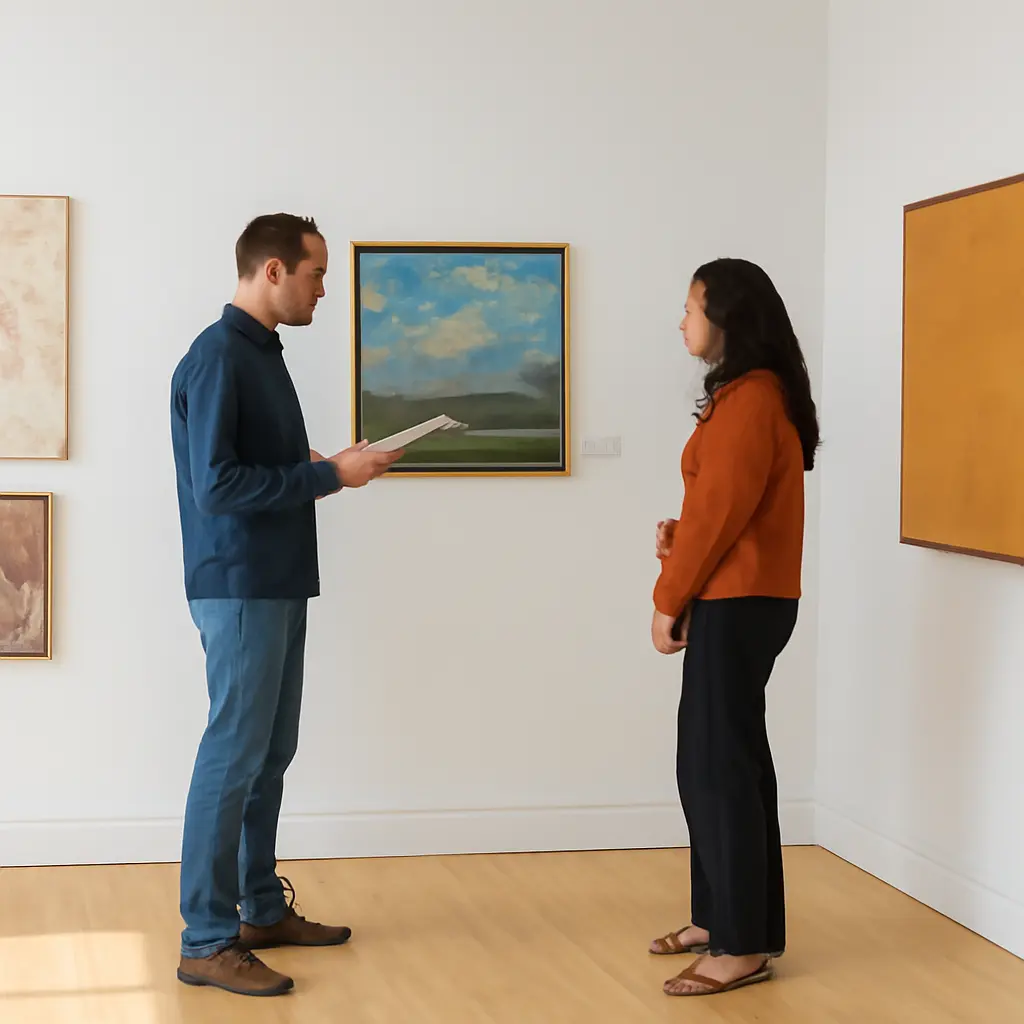
A neighborhood gallery can celebrate cultural traditions while also turning them into décor, branding, or profit for people with little connection to the communities that created them. Cultural appropriation in these spaces is the adoption or presentation of cultural expressions without meaningful context, permission, credit, or fair benefit—especially when unequal power lets outsiders profit while source communities are misrepresented or excluded. The line is not simply “cross-cultural influence versus no influence”: it depends on who controls the story, how specific cultural material is used, whether community members have agency, and who gains. Those questions matter in a U.S. arts sector where nonprofit arts and culture organizations generated an estimated $151.7 billion in economic activity in 2022, according to the Arts & Economic Prosperity 6 study, even as local artists and culture-bearers may struggle for visibility and compensation.
Cultural appropriation defines the power relationship behind gallery practice
Cultural appropriation has no single universally accepted legal or scholarly definition. In Who Owns Culture? Appropriation and Authenticity in American Law, legal scholar Susan Scafidi describes it as taking intellectual property, traditional knowledge, cultural expressions, or artifacts from someone else’s culture without permission. That definition helps identify the act, but ethical analysis also asks about power, context, attribution, and benefit. Borrowing is not automatically appropriation; neither does good intent erase harm.
For neighborhood galleries, the relevant “entity-attribute” pairing is cultural appropriation as a feature of curatorial and commercial practice. It may appear in an exhibition, a gallery’s promotional language, the sale of culturally specific objects, or the use of community symbols to make a venue seem edgy or authentic. The pattern is more concerning when people from the source community are absent from decision-making, while outsiders receive the attention, income, or institutional credibility.
A useful distinction is between cultural exchange—reciprocal learning and influence—and appropriation, in which unequal power or extractive use shapes the relationship. The distinction is contextual, not a checklist that can declare every case harmless or harmful. A community is also not a single voice: artists, elders, organizers, and diaspora members may disagree about what is appropriate. That makes consultation and transparent decision-making more reliable than a gallery’s assumption that one spokesperson can grant blanket permission.
Power and access
Power concerns who can define a culture publicly and who can correct a misrepresentation. A gallery may have control over wall text, sales, press coverage, and institutional relationships, while the people whose traditions are represented have little control over those same channels. The Smithsonian’s National Museum of the American Indian, in its guidance on exhibitions and cultural representation, emphasizes consultation and collaboration with source communities. Applied locally, that means involving relevant artists and knowledge-holders before the exhibition concept and budget are fixed—not merely asking for approval after decisions have been made.
Attribution, consent, and cultural specificity
Attribution identifies who made a work and, where relevant, the cultural and historical context it belongs to; consent concerns whether and how material may be used. Neither is interchangeable with the other. A credit line does not by itself authorize use of restricted or sacred material, and permission from an individual artist does not necessarily represent the consent of an entire community. Galleries should name artists accurately, explain uncertainty honestly, and avoid treating broad labels such as “Indigenous,” “African,” or “Asian” as substitutes for specific provenance and context.
Commercial benefit and control
Commercial benefit includes more than the sale price of an object. It can include admission income, commissions, publicity, donor interest, and the gallery’s reputation. The United Nations Declaration on the Rights of Indigenous Peoples recognizes Indigenous peoples’ rights to maintain, control, protect, and develop their cultural heritage and traditional cultural expressions. It is a declaration rather than a universal licensing code, but it sets an important ethical benchmark: galleries should ask who controls the representation and who shares in its benefits.
Gallery practices reveal appropriation through display, storytelling, and sale
The definition becomes practical when applied to the choices a gallery makes. Appropriation is not limited to copying a recognizable motif. It can also occur through decontextualized display, inaccurate storytelling, or the use of cultural identity as a marketing device. The following forms often overlap, so a gallery should assess the whole relationship rather than treat each object as an isolated case.
Motif borrowing and imitation
Motif borrowing occurs when an artist or business adopts patterns, designs, garments, symbols, or techniques associated with another culture. Some visual forms are shared, openly taught, or part of long histories of exchange; others may be community-specific, sacred, or tied to particular makers. The key questions are where the design came from, whether its use is restricted, whether the source is credited, and whether the borrowing reproduces an unequal market relationship. Galleries should not assume that a motif is freely available simply because it appears online or in a museum collection.
Decontextualized display
Decontextualization happens when an object or practice is presented as exotic decoration, timeless tradition, or anonymous “folk” material, detached from its makers and living context. This can make contemporary communities seem absent from the present or reduce varied histories to a visual theme. The American Alliance of Museums’ ethical guidance stresses stewardship, accurate interpretation, and respect for communities connected to collections. A neighborhood gallery can put that principle into practice with specific labels, artist-approved interpretation, and space for contemporary voices rather than relying on spectacle alone.
Commercialization without fair benefit
Commercialization becomes ethically troubling when a gallery profits from cultural material while the artists or source communities receive little compensation, credit, or decision-making power. The imbalance can be especially stark when a gallery sells objects described as culturally authentic but cannot identify their makers or supply chain. The U.S. Indian Arts and Crafts Act illustrates that cultural misrepresentation can have consequences beyond criticism: it is a truth-in-marketing law that prohibits falsely marketing products as Indian-made when they are not made by an enrolled member of a federally or state-recognized tribe, or a certified Indian artisan. The law’s scope is specific; it does not resolve every ethical question about appropriation, but it underscores the importance of truthful provenance.
Community collaboration offers a more accountable alternative
Avoiding appropriation does not require galleries to avoid cross-cultural work. It requires moving from extraction toward relationships in which affected artists and communities have meaningful agency. Collaboration is not a public-relations label: it should change who helps set the exhibition’s goals, controls interpretation, receives payment, and can raise concerns.
Consult before the exhibition is designed
Early consultation gives community participants a real opportunity to shape the premise, selection, language, and safeguards. Galleries should identify whose knowledge is relevant, compensate people for their labor, and make clear whether feedback is advisory or decision-making. Consultation should not be reduced to asking one person to speak for a diverse community, nor should participation be treated as a free favor.
Share authority, credit, and revenue
Shared authority can include co-curation, artist approval of interpretive text, transparent sales terms, and community partners’ ability to set conditions for use. Fair compensation should cover not only artworks but also talks, research, translation, consultation, and reproduction rights. Where culturally sensitive material is involved, the gallery should discuss whether it should be displayed at all, rather than presuming that public exhibition is the default.
Build a process for correction and repair
Even careful projects can make mistakes. Galleries should provide a clear way for artists and community members to flag errors, correct labels, request changes, or ask for removal of material. A meaningful response acknowledges the specific harm, explains what will change, and follows through. Defensiveness—especially the claim that good intentions settle the matter—usually deepens distrust rather than repairing it.
A practical review can test a gallery’s cultural responsibility
Before opening an exhibition or putting culturally specific work on sale, a gallery can use a short review to turn abstract principles into concrete decisions. The review should be documented, revisited as the project develops, and informed by the people most closely connected to the material.
- Can the gallery identify the artists, cultural context, and provenance of the work?
- Have relevant artists or community knowledge-holders been consulted early and compensated?
- Are any designs, stories, objects, or practices sacred, restricted, or governed by community protocols?
- Who controls the interpretation, photography, reproduction, and sale of the work?
- How are revenue, visibility, and professional opportunities shared?
- Is there a clear process to respond to correction requests or concerns?
A chart accompanying this review could compare each exhibition’s consultation, attribution, compensation, and consent measures, making gaps visible across programming rather than leaving them to individual curators’ memories. Such a scorecard should guide discussion, not pretend that complex cultural relationships can be reduced to a single numerical rating.
Conclusion: cultural responsibility strengthens neighborhood galleries
Cultural appropriation in neighborhood galleries is best understood through power, attribution, consent, and benefit—not through a simplistic rule that cultures must never influence one another. Motif borrowing, decontextualized display, and commercialization without fair benefit can turn cultural expression into an asset for institutions while its makers remain unheard. Early consultation, shared authority, accurate provenance, fair compensation, and a credible process for repair offer a more accountable path.
The broader implication is that a gallery’s cultural credibility depends not only on what it displays, but on how it builds relationships and distributes opportunity. Artists, visitors, and gallery leaders can begin by asking who made the work, who tells its story, and who benefits from its presence. For further guidance, consult the Smithsonian’s community engagement resources, the American Alliance of Museums’ ethics materials, and the National Museum of the American Indian’s exhibition guidance.
Sources: Scafidi, Susan, Who Owns Culture? Appropriation and Authenticity in American Law, Rutgers University Press, 2005, https://www.rutgersuniversitypress.org/who-owns-culture/9780813535627/; Americans for the Arts, Arts & Economic Prosperity 6, 2023, https://aep6.americansforthearts.org/; Smithsonian National Museum of the American Indian, Developing an Exhibition, https://americanindian.si.edu/explore/exhibitions/item?id=; United Nations, United Nations Declaration on the Rights of Indigenous Peoples, 2007, https://www.un.org/development/desa/indigenouspeoples/declaration-on-the-rights-of-indigenous-peoples.html; American Alliance of Museums, Code of Ethics for Museums, https://www.aam-us.org/programs/ethics-standards-and-professional-practices/code-of-ethics-for-museums/; U.S. Federal Trade Commission, Indian Arts and Crafts Act, https://www.ftc.gov/business-guidance/resources/indian-arts-crafts-act.