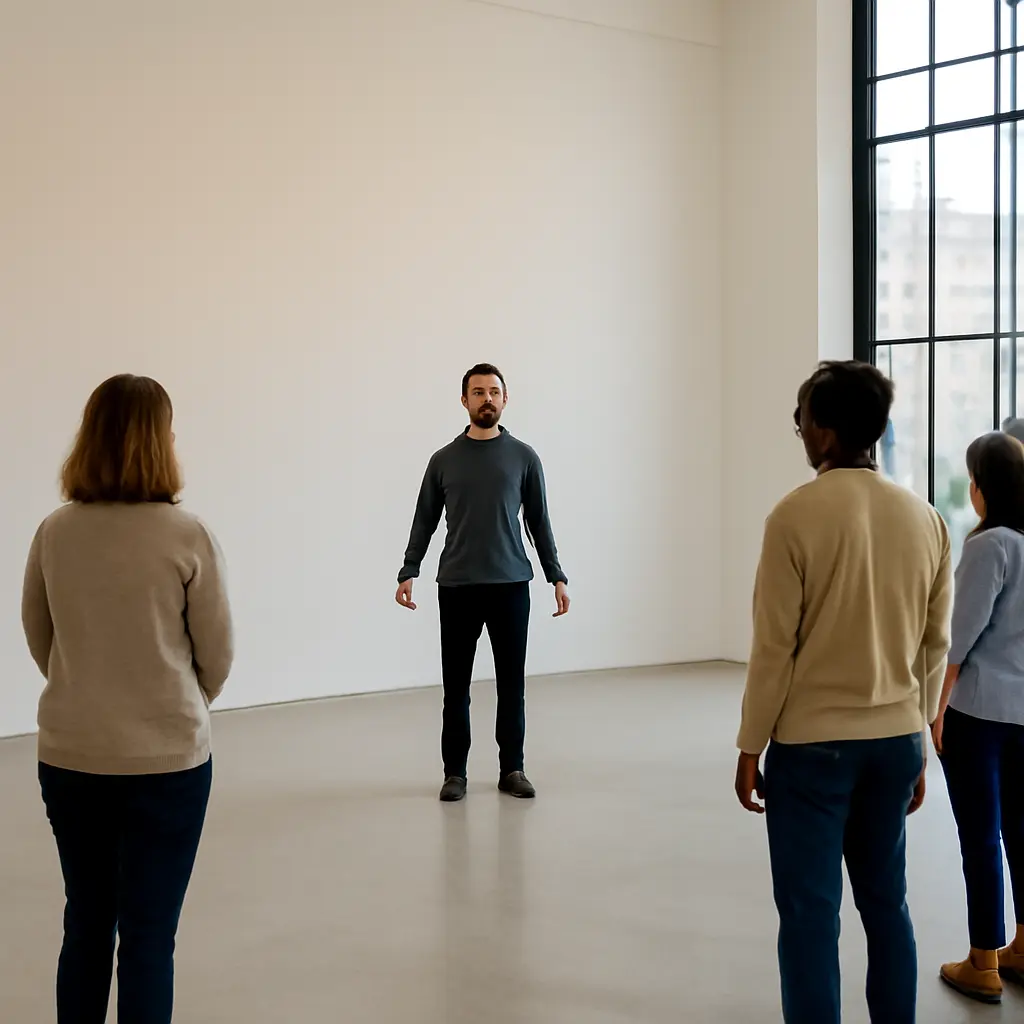
Performance art is live work in which an artist uses their body, actions, time, and audience relationship as the medium. Its value is not measured by whether the performer looks polished or conventionally attractive, but by how fully the work engages attention and creates a felt encounter. That distinction matters in a culture saturated with images: the National Endowment for the Arts reported that 48.3% of U.S. adults attended at least one visual or performing arts event in person in 2022, while performance art asks audiences to notice the singular, shared presence that an image cannot reproduce. Understanding that presence means looking at the form’s defining qualities, its varied practices, and examples that show how vulnerability, endurance, and participation can matter more than appearance.
Performance art presence: what the attribute means
“Presence” in performance art describes the performer’s active, perceptible engagement with the present moment: the body is there, doing something, in relation to a place, duration, and audience. It is not simply confidence, charisma, or a fixed look. Art historian RoseLee Goldberg, in her history Performance Art: From Futurism to the Present, traces performance as a medium through which artists test ideas directly in time and space, often challenging the boundaries between art and everyday life.
That definition distinguishes performance art from a presentation designed mainly to produce an attractive image. A work may be quiet, awkward, repetitive, strenuous, or still. Its formal choices—gesture, breath, duration, sound, proximity, and the possibility of change—shape the audience’s experience. The result can be visually striking, but beauty is not a requirement or a reliable measure of artistic success.
The live body as medium
In performance art, the body is not merely a subject to be looked at; it is a working medium. A performer can use posture, movement, speech, fatigue, or stillness to make an idea tangible. This can foreground questions of identity, labor, power, or vulnerability without relying on conventional theatrical characters or a polished visual presentation.
The body also makes the event specific. A performance happens with particular people in a particular place, and no later photograph or recording can preserve every aspect of that encounter. The image documents an event; it does not contain the same shared duration, atmosphere, or possibility of response.
Duration, attention, and shared time
Duration is the time a work asks performers and viewers to spend with it. A brief gesture can feel intense, while a long, repetitive action may make patience, boredom, or exhaustion part of the subject. The length is not automatically meaningful: it matters when it changes how audiences attend to the work and to their own presence.
This emphasis on time is one reason performance resists the idea that art must immediately please the eye. The viewer may have to wait, adjust, or decide whether to stay. Presence is therefore relational: the artist offers an action, and the audience’s attention helps complete the event.
Performance art practices that make presence tangible
The broad category includes distinct approaches rather than one visual style. Body-based action, endurance, participation, and durational work can all make presence central, but each organizes the relationship between artist and audience differently. These are related practices, not a definitive list of mutually exclusive genres.
Action and gesture
Action-based performance uses a deliberate act—sometimes ordinary, sometimes disruptive—as its primary structure. A repeated movement, a task performed in public, or a gesture directed toward an object can shift attention from appearance to intention and consequence. Viewers may ask what the action means, how it feels to witness, and what assumptions it exposes.
Endurance and durational performance
Endurance performance makes sustained effort, limits, or the passage of time part of the work. Marina Abramović’s The Artist Is Present at the Museum of Modern Art in New York in 2010 invited visitors to sit silently across from her, one at a time. MoMA reported that the performance ran for 736 hours and 30 minutes over nearly three months, and that 1,545 people sat opposite Abramović. The work’s force came not from a costume or dramatic spectacle, but from the discipline of maintaining a direct encounter and the varied responses it produced.
Endurance does not mean that suffering is necessary for meaningful art. Rather, duration can reveal effort and attention that a quick glance might miss. Ethical practice also requires artists and institutions to consider safety, consent, accessibility, and the conditions under which performers work.
Audience participation and relational presence
Participatory performance gives viewers a role beyond observation. They may make a choice, speak, move through a space, or simply decide whether to approach. The invitation can create intimacy, but participation should not be confused with unrestricted consent: clear boundaries and the freedom to decline help make interaction meaningful rather than coercive.
In Abramović’s MoMA performance, sitting across from the artist was optional, and the visitor’s decision to take part shaped each encounter. The format made spectatorship visible: a person could watch others, join the queue, sit, or leave. In that way, presence belonged to both performer and audience, though the roles and responsibilities were not identical.
Why presence matters beyond appearance
Performance art offers a way to encounter ideas through time, bodies, and attention rather than through visual polish alone. Its immediacy can make social relationships and embodied experience perceptible, while its live nature leaves room for uncertainty. This does not make appearance irrelevant: clothing, setting, and visual composition can all carry meaning. It means they serve the work instead of acting as its sole measure.
A measure of engagement, not attractiveness
A useful question is not “Does the performer look pretty?” but “What is this work asking me to notice, and how does the performer’s presence make that question felt?” The answer may involve discomfort, tenderness, humor, impatience, or recognition. A performance need not be pleasant to be compelling, and a visually beautiful work may still be powerful when beauty is used deliberately rather than treated as an obligation.
Access, documentation, and who gets to be seen
The emphasis on a live body also raises questions about access and representation. Not every audience member can attend in person, remain standing, tolerate intense sensory conditions, or participate physically. Captions, seating, quiet spaces, clear event information, and thoughtful documentation can widen access without pretending that a recording is identical to the live event.
Documentation matters because performance often survives through photographs, video, reviews, and artists’ accounts. Those records help future audiences study work that has ended, but they can also narrow attention to a memorable image. Looking beyond the image—toward the work’s duration, conditions, and relationships—helps keep its central questions in view.
Conclusion: performance art is an encounter
Performance art makes presence its material: a live body acts within time and space, and an audience encounters that action directly or through its documentation. Action-based, endurance, durational, and participatory practices show how attention and relationship can matter more than conventional attractiveness. The scale of public arts attendance reported by the National Endowment for the Arts underscores the continuing relevance of shared cultural experiences, while The Artist Is Present demonstrates how a simple structure can sustain thousands of individual encounters.
When you encounter performance art, take time to notice the action, the duration, the performer’s conditions, and your own response before judging how it looks. For further context, explore RoseLee Goldberg’s history of performance art and the Museum of Modern Art’s documentation of Abramović’s 2010 work. The deeper question is not whether a performance looks perfect, but whether it makes us more attentive to the people and moment before us.
Sources: National Endowment for the Arts, “Arts Participation Patterns in 2022: Highlights from the Survey of Public Participation in the Arts,” https://www.arts.gov/impact/research/publications/arts-participation-patterns-2022-highlights-survey-public-participation-arts; RoseLee Goldberg, Performance Art: From Futurism to the Present, Thames & Hudson, https://thamesandhudson.com/performance-art-9780500204450; Museum of Modern Art, “Marina Abramović: The Artist Is Present,” https://www.moma.org/calendar/exhibitions/964.